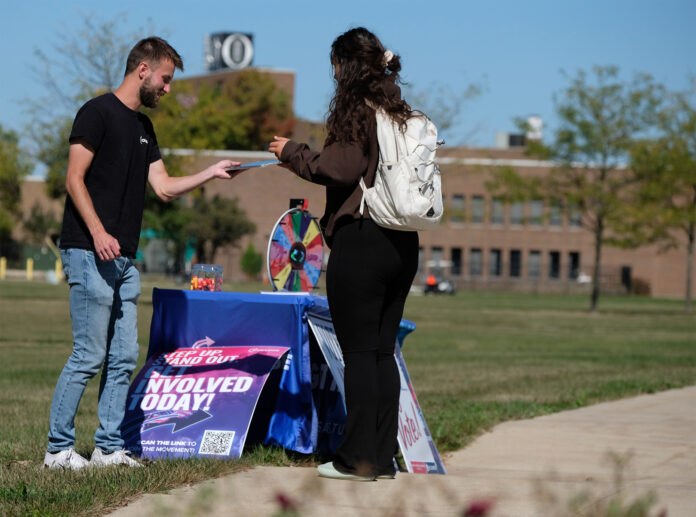
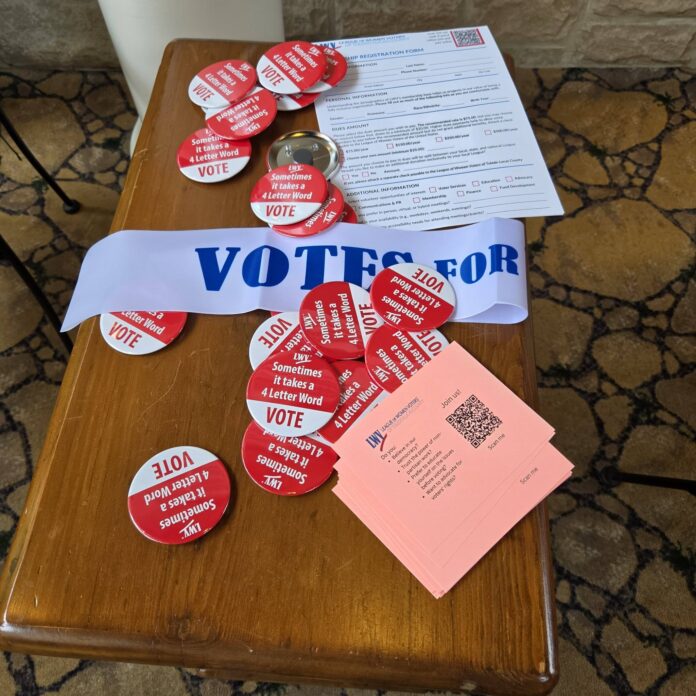
Lucas Zielinksi, with Turning Point USA, hands Amelia Mathkour, a music, business and tech major at Owens Community College, a pamphlet about voting registration. Zielinksi said he was on campus for the day to help students register to vote. (TFP Photo/Lori King)
Lucas County Board of Elections explains voting details, process
Toledo – With Election Day a month away, preparations are in full swing at the Lucas County Board of Elections office.
“We’re up and running and getting everything ready,” said Timothy Monaco, deputy director of the elections office. “It’s a wonderful time. It’s important to exercise your right to vote.”
Logistics that the staff and officers have been handling for weeks on behalf of Lucas County’s 303 voting precincts include preparing ballots, training precinct election officials, and getting early voting dates and times posted on their website.
Monaco said the most commonly asked question from voters during the past couple of weeks has been when absentee ballots will arrive in the mail.
Here’s the answer: Ohio voters can look for the absentee ballots starting Oct. 8, which is one day after registration ends for the Nov. 5 election.
The Lucas County Board of Elections staff doesn’t give predictions on voter turnout, Monaco said. But, according to state election records, 67 percent of registered Lucas County voters participated in the 2020 presidential election, and 66 percent did so in the 2016 presidential election. This participation includes absentee voting, early in-person voting and traditional Election Day voting.
Those choices are meant to help all eligible voters participate, whether they prefer going in person to a local polling site or to cast a ballot before they travel out of town.
“It’s important to make your plan as to who you are going to vote for,” Monaco said. “Make sure you make a plan and know what is on your ballot.”
While the presidential campaign is the key race of the Nov. 5 election, there are also races in Lucas County for local judges and city officials. For those who want to see the list ahead of time, ballot proofs are available for review on the election board’s website.
“Ballots will be three pages for everyone and four pages for some,” Monaco said.
While some people remember how they wish to vote when going to the polls, others find it helpful to bring paper notes or refer to a list on their phone, Monaco said. “Some folks really come prepared,” he said.
“It’s also important to be respectful at the location,” he added, referring to an Ohio law that prohibits photos of marked ballots. “We do ask that you limit cell phone use at the ballot.”
Military and overseas civilian voting: Started Sept. 20.
Voter registration deadline: 9 p.m. Oct. 7.
Early in-person voting season: Oct. 8.-Nov. 3.
Absentee ballot postmark deadline: Nov. 4.
Election Day: Nov. 5.
CAMPUS TALK
OWENS COMMUNITY COLLEGE STUDENTS SOUND OFF ABOUT VOTING
Question: How important is voting to you?
Oliver OdendahlJames JohnsonNivant DawsonSydney StanleyDavid Case III
Voting is not my main concern, but it is pretty important because it is the future of America and I would like to have a say in what is gonna be my future. I usually try to vote on voting day, if I can’t I’ll do the absentee ballot.
Oliver Odendahl | EMT Major | Tontogany Resident
I am not a registered voter. If I was to lie to you I’d say yes. But honestly, I don’t have enough time … it’s not really a main priority, even though it should be. I do plan on voting at some point, maybe when I’m in my adult phase. Even though I’m not a registered voter I do think voting is important because it basically determines the society and the rules and regulations we live by.
James Johnson | Broadcast Media Technology Major | Toledo Resident
I’d say voting is very important. There’s certain aspects of it that do feel sort of depressing, when you think about it, because a lot of people would say people voting normally wouldn’t matter because of a small majority in the Electoral College – their votes matter 100 times more than your own. That’s what it feels like at least from what I know. It does feel a little degrading knowing that’s going to happen.
Nivant Dawson | Business Major | Toledo Resident
I think voting is important, but I’m not exactly sure why it’s important. I mean, there’s a lot of things that come from it. You’re voting for someone that you’re putting your trust and you’re faith into to guide us all in the right direction, but we just all don’t know what that direction is yet. So, we’re just kind of free-balling it, in a way. So, I don’t know … I’ve never voted before but this will be interesting. I really don’t know what all is involved. I just have a lot to learn about voting – like what I should be looking for in the leader I’m going to be voting for. So, yeah, it’s coming up soon. There’s a lot to learn.
Sydney Stanley | Chemistry Major | Millbury Resident
Voting is very important, especially in this day and age, when everything’s going on.
David Chase III | Literature Major | Toledo Resident
Registration details

Ohio voters must be registered by 9 p.m. Oct. 7 to be eligible to vote in the Nov. 5 election.

Residents can register to vote, look up voter registration, change their address, find an early voting location, look up Election Day polling location or track an absentee ballot at VoteOhio.gov.

Photo ID requirement

Bring your photo ID when voting. The options are:

- Current Ohio driver’s license or State of Ohio ID card.

- Interim ID form issued by Ohio Bureau of Motor Vehicles.

- U.S. passport or U.S. passport card.

- U.S. military ID card, Ohio National Guard ID card or U.S. Department of Veterans Affairs ID card.

A registered voter who has changed his or her name since the photo ID was issued will need to show proof of legal name change and sign a form. A photo ID card can show a former address if a current address is on file with the voting records. If you forget a photo ID, you can request a provisional ballot.

How to vote absentee

An absentee ballot in Ohio needs to be requested, signed, dated and submitted for each election. Military personnel and civilian overseas voters can file one application for all elections happening in a given year.

The application asks for the number on your Ohio driver’s license or Ohio ID card, last four digits of your social security number, or a photocopy of other eligible ID such as a U.S. passport or military ID.

Mailed absentee ballots must be postmarked by Nov. 4 and can be hand delivered to the Board of Elections on Nov. 5.

Additional instructions are on the Ohio Secretary of State’s website.

In-person early voting

Ohio’s in-person early voting season begins Oct. 8 and ends Nov. 3.

The Lucas County Early Vote Center is at 3737 W. Sylvania Ave. Suite 121 Entrance C (at the rear of the Lucas County Board of Elections building) in west Toledo.

Voting times and dates can be found at LucasCountyOhioVotes.gov.

Election Day voting

Polling sites are open in Ohio from 6:30-7:30 p.m. on Nov. 5. You can look up your polling location at VoteOhio.Gov.

What’s on the ballot?

A “ballot proof” is available for review on the Lucas County Board of Elections page. It lists candidates and ballot issues by precinct, so voters know what to expect.

For example: Six president/vice president candidate teams have declared in Ohio, with an additional write-in option available. Other candidate races include U.S. Senator, Lucas County Sheriff and openings on Toledo City Council.

Ohio Issue 1 is a proposed state constitutional amendment that has gained a lot of attention. This issue, if approved, would designate a redistricting commission to draw state legislative and congressional districts.

There are other issues locally, such as a proposed bond issue for the Toledo-Lucas County Public Library and a tax renewal request from the Toledo-Lucas County Port Authority.

Are ballot “selfies” allowed?

Ohio does not permit photos to be taken of a marked ballot. It’s actually a fifth-degree felony should that take place, according to Ohio law.

The “I Voted” Sticker

A traditionally popular way to showcase voter participation is through an “I voted” sticker, picked up on Election Day at the polling site.

Ohio’s current “I Voted” sticker design was adopted in 2019 through a student art contest. A red squiggle depicts a map of Ohio, nestled in a blue circle outline, with the phrase “Ohio Voted.”

Voters are invited to download the image to share on social media at the Ohio Secretary of State website. That website also has also a “future voter” coloring page for children available for download.

Is campaigning allowed at election sites?

Ohio does not allow election campaigning, also known as electioneering, within 100 feet of a voting site. This means no campaigning messages on attire such as shirts or hats, Monaco said.

Two small United States flags are placed at each voting site to designate the “neutral” zone where this applies.

Where is the Board of Elections office?

If you need to visit the Lucas County Board of Elections regarding a voting matter, that office moved about two years ago from its former location at One Government Center to 3737 W. Sylvania Road in West Toledo.

When are election numbers official?

Ballots cast on Election Day will be delivered in person to the Lucas County Board of Elections for the counting procedures.

There will be numbers reported after that count is complete.

The Ohio Secretary of State does not consider voter counts to be official until two or three weeks later, after provisional ballots are accounted for and to give time for absentee ballots to arrive that met the postmark deadline.
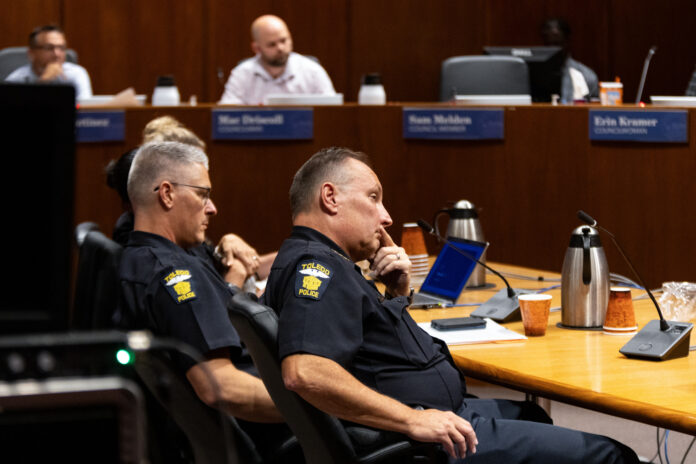
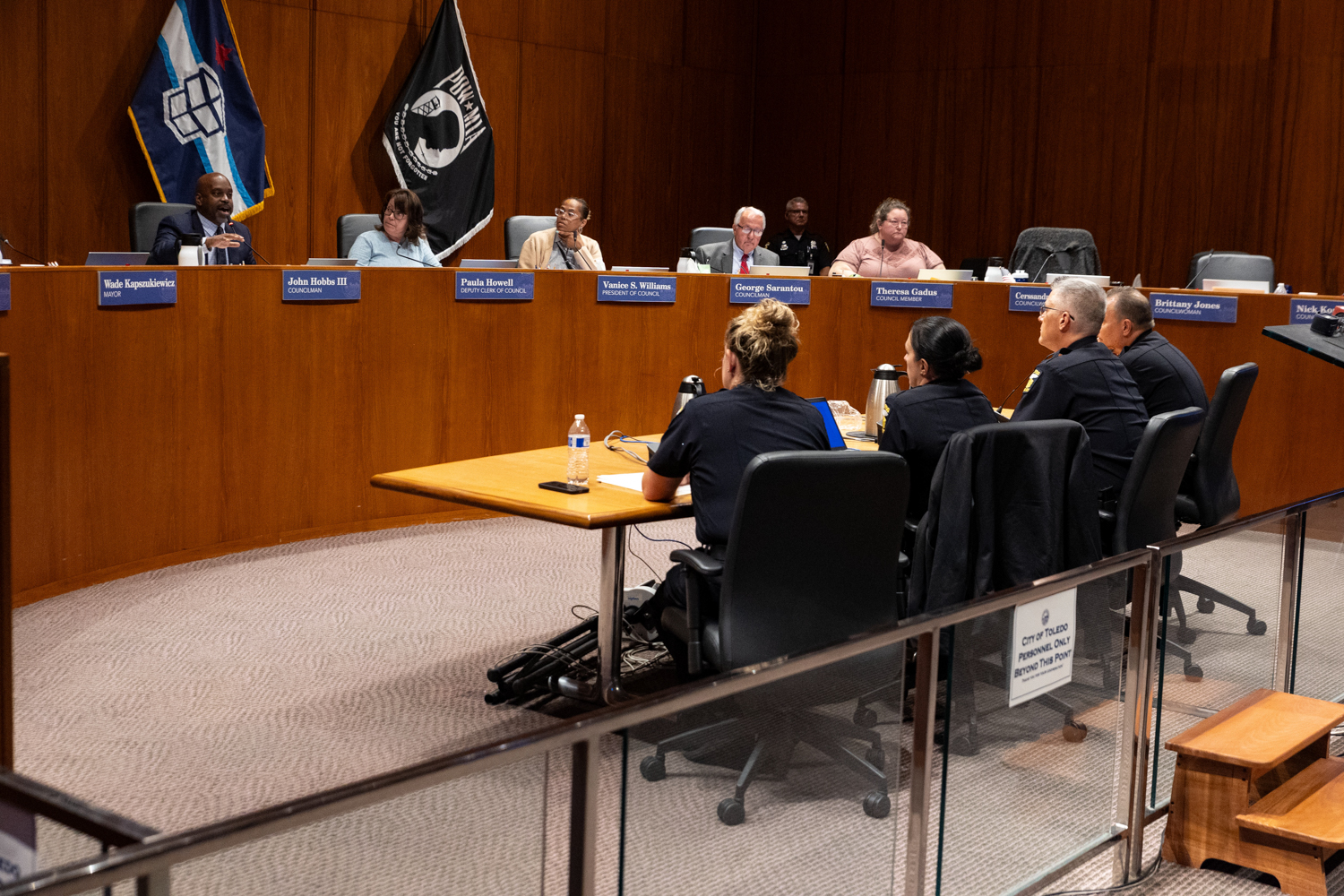
Assistant Police Chief Kevin Braun and Police Chief Michael Troendle listen to questions from Toledo City Council members about Flock Group, Inc.’s automatic license plate reader cameras (ALPRs) during a Public Safety & Criminal Justice Reform Committee Meeting inside Toledo City Council Chambers on Thursday, Sept. 17. (TFP photo by Stephen Zenner)
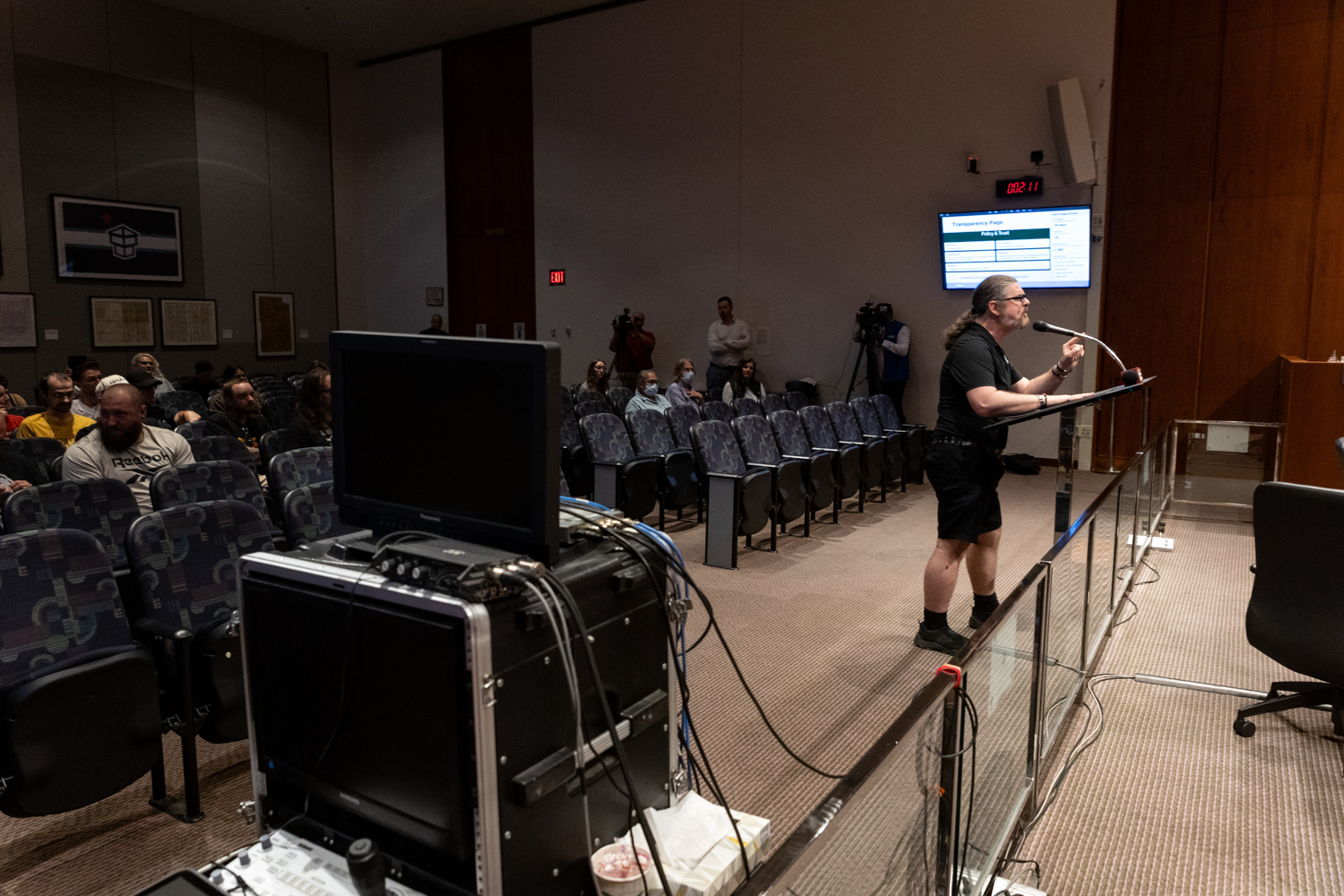
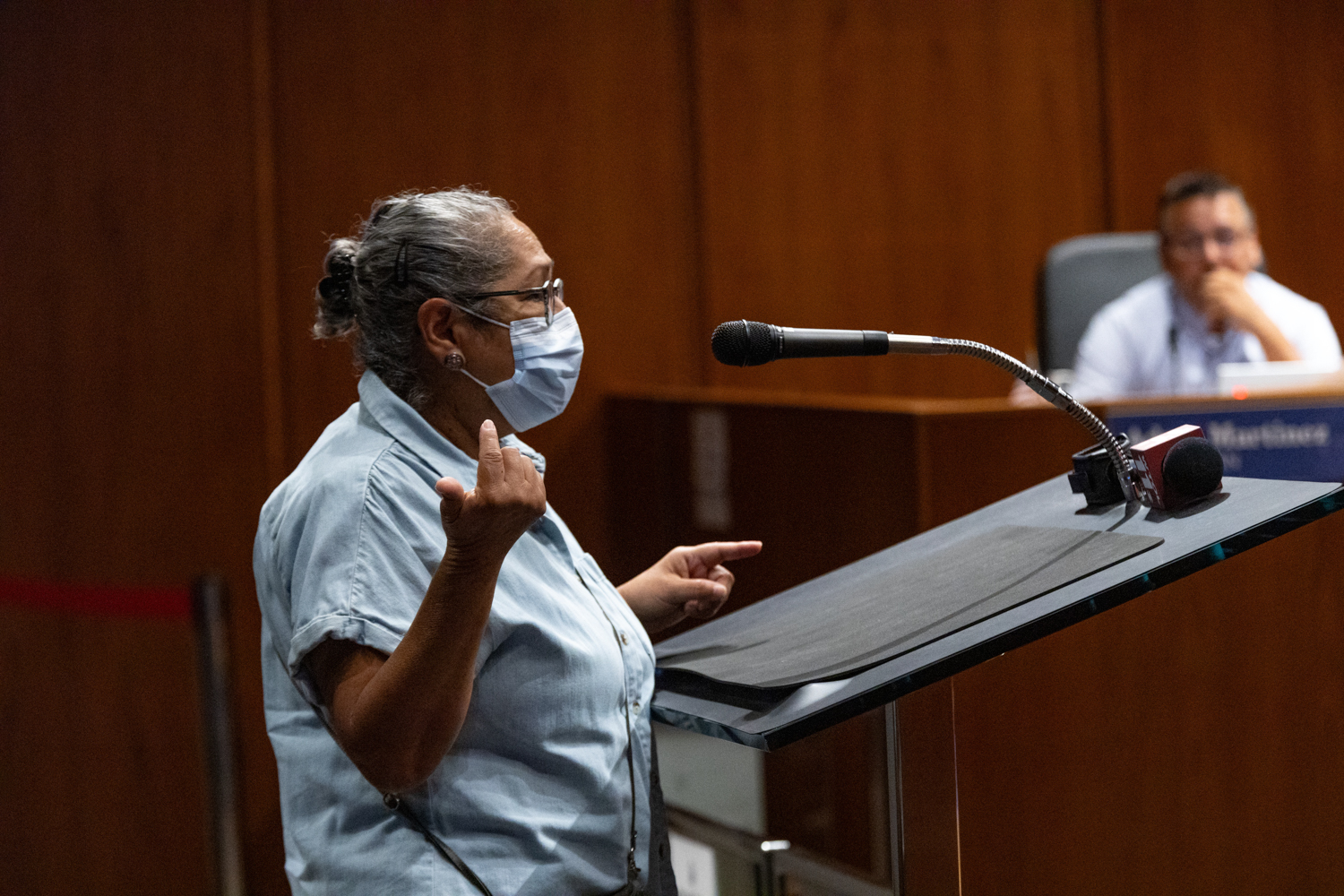
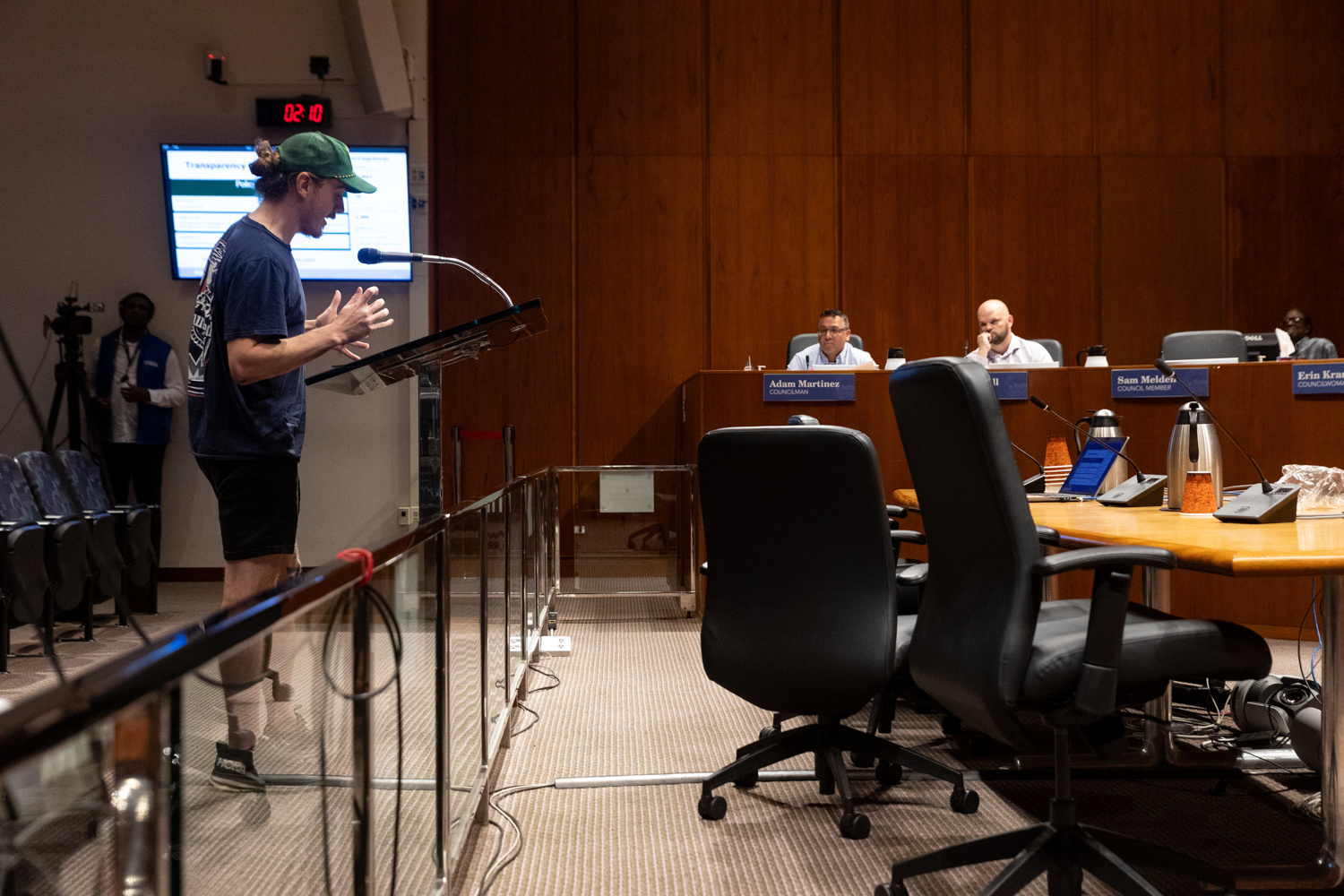
TOLEDO – During a Sept. 17 Public Safety & Criminal Justice Reform Committee meeting, public comments were centered on the use of Flock cameras. Specifically, the meeting was about the possibility of an extra year of funding for a mobile command center and an expansion of cameras into District 2 Schools and thoroughfares.
Most speakers criticized the demeanor of council members and the structure of the meeting, which allowed council members to speak and ask questions before public comment. They saw the format and some of the questions as leading, condescending and not dealing with the Flock critics’ actual concerns.
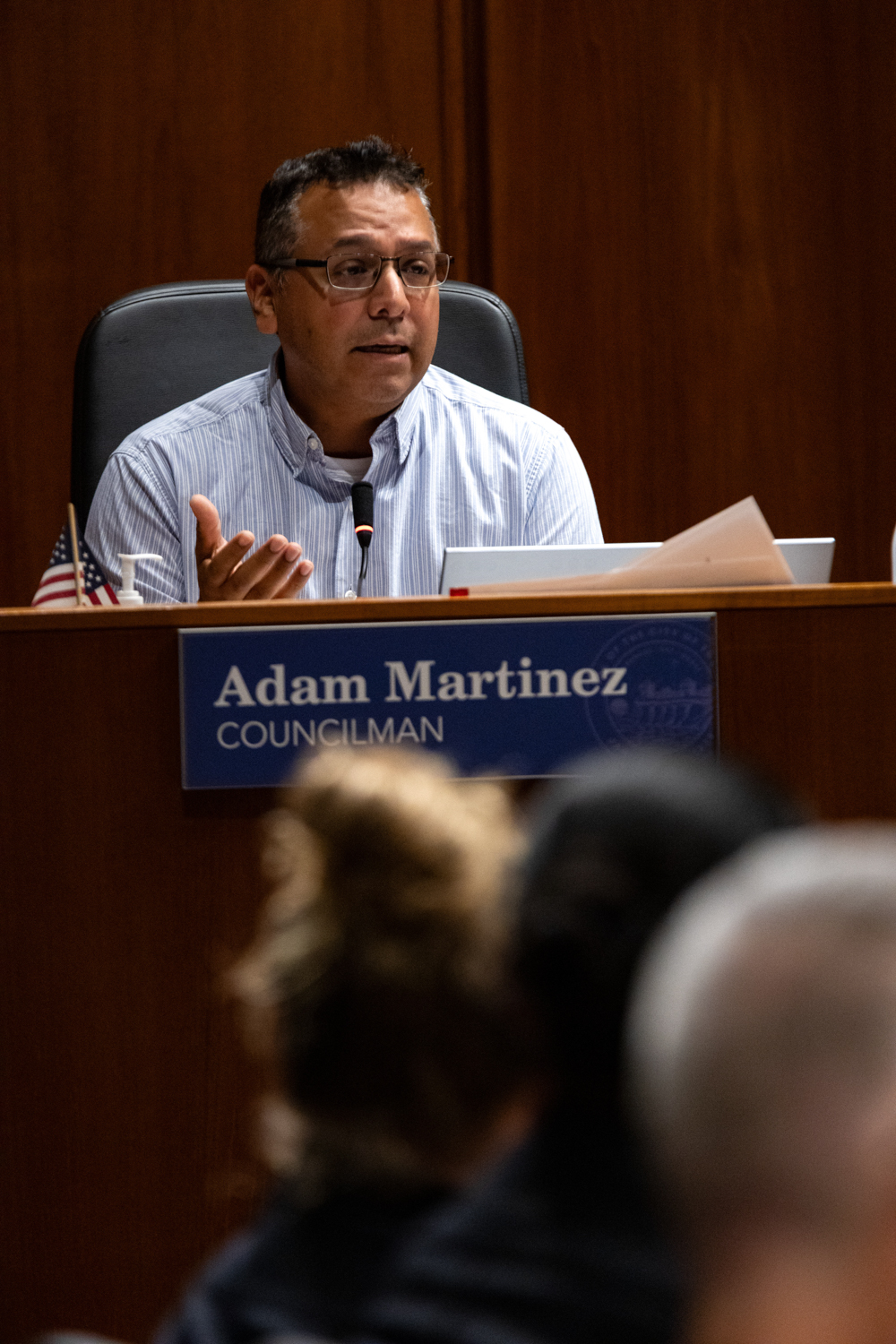
Council remained split on Flock, with Vanice Williams, Adam Martinez and George Sarantou firmly in favor, Theresa Gadus and Erin Kramer firmly against, and Mac Driscoll somewhere in-between. The police panel gave more information on Flock, and the basic pro-Flock stance was that it was an effective tool for solving crimes. Those in opposition generally were concerned about how and where mass location data could be sold/used against them.
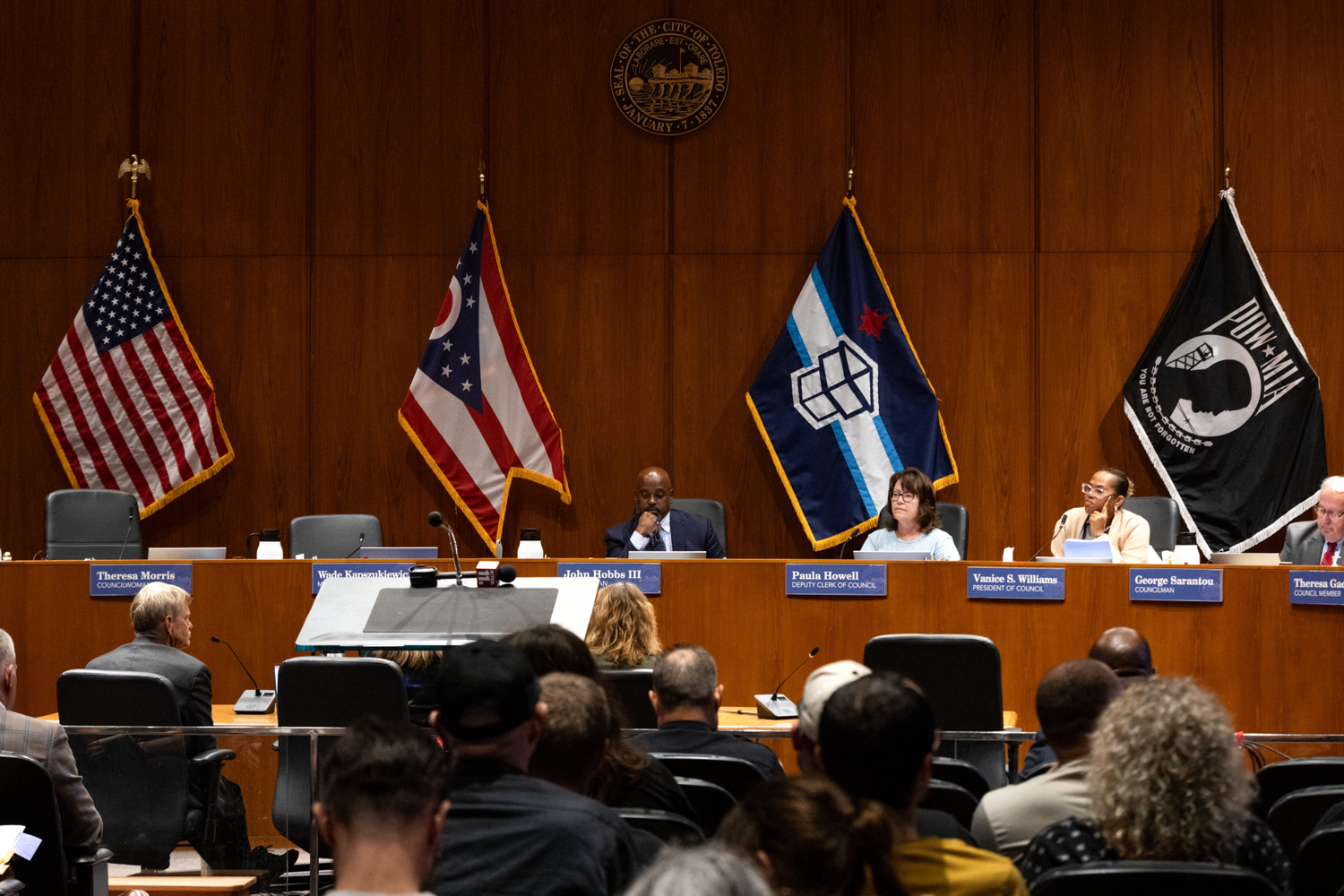
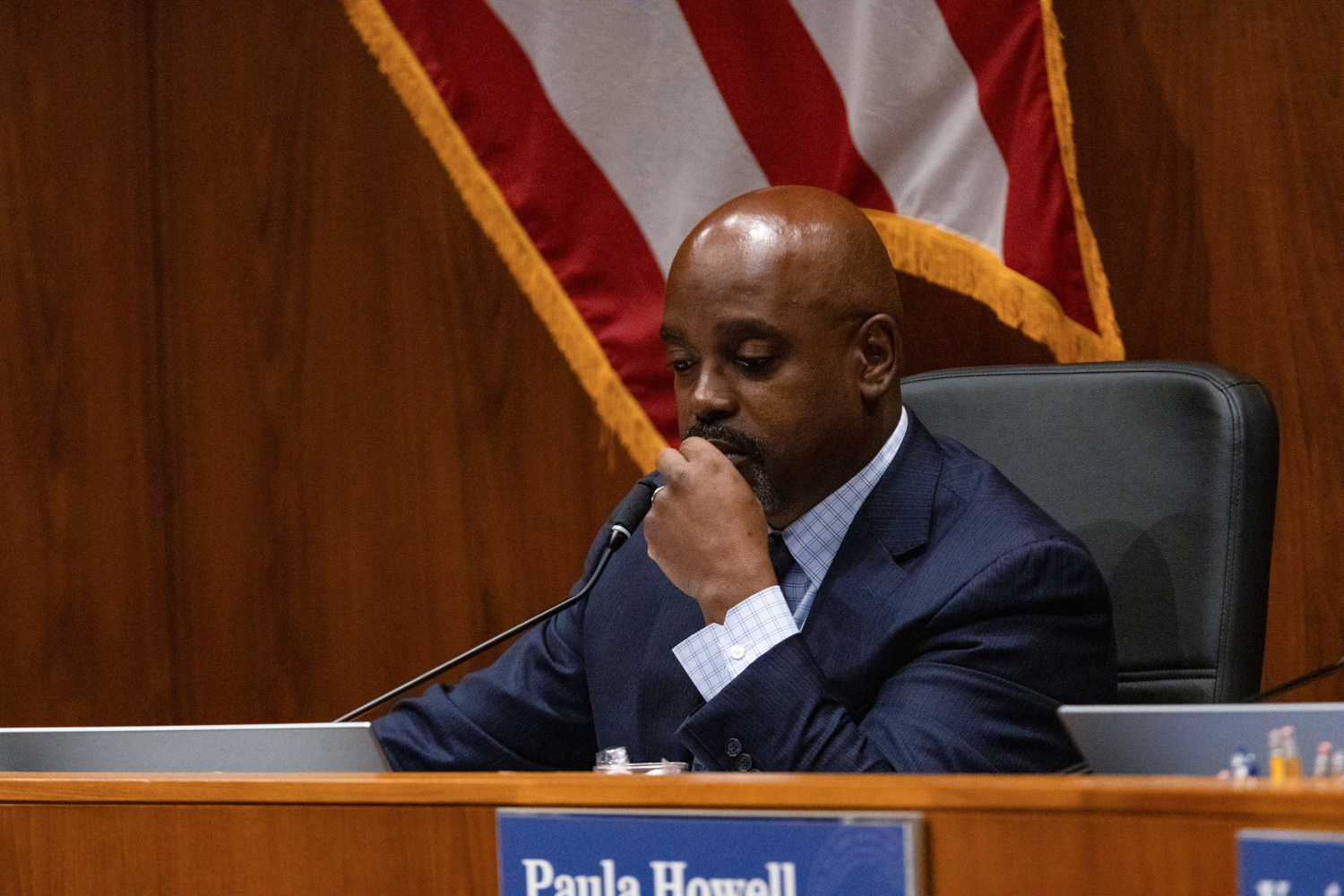
John Hobbs III, the chair of the Public Safety & Criminal Justice Reform Committee and Toledo City Council representative for District 1, presides over the Public Safety & Criminal Justice Reform Committee Meeting. (TFP photo by Stephen Zenner)
The majority of the public comment was opposed to the use of Flock cameras due to the risk for immigrant communities, the overreach of federal government, the lack of an independent audit and the potential misuse of the tool.
Both those for and against the use of Flock cameras agreed that an independent audit was necessary to keep Toledoans safe.
Nationwide backlash against Flock Group, Inc.’s automated license plate reader (ALPR) cameras led to this public meeting.
Adam Martinez, Toledo city councilman representing District 2. (TFP photo by Stephen Zenner)
Criticisms of the meeting
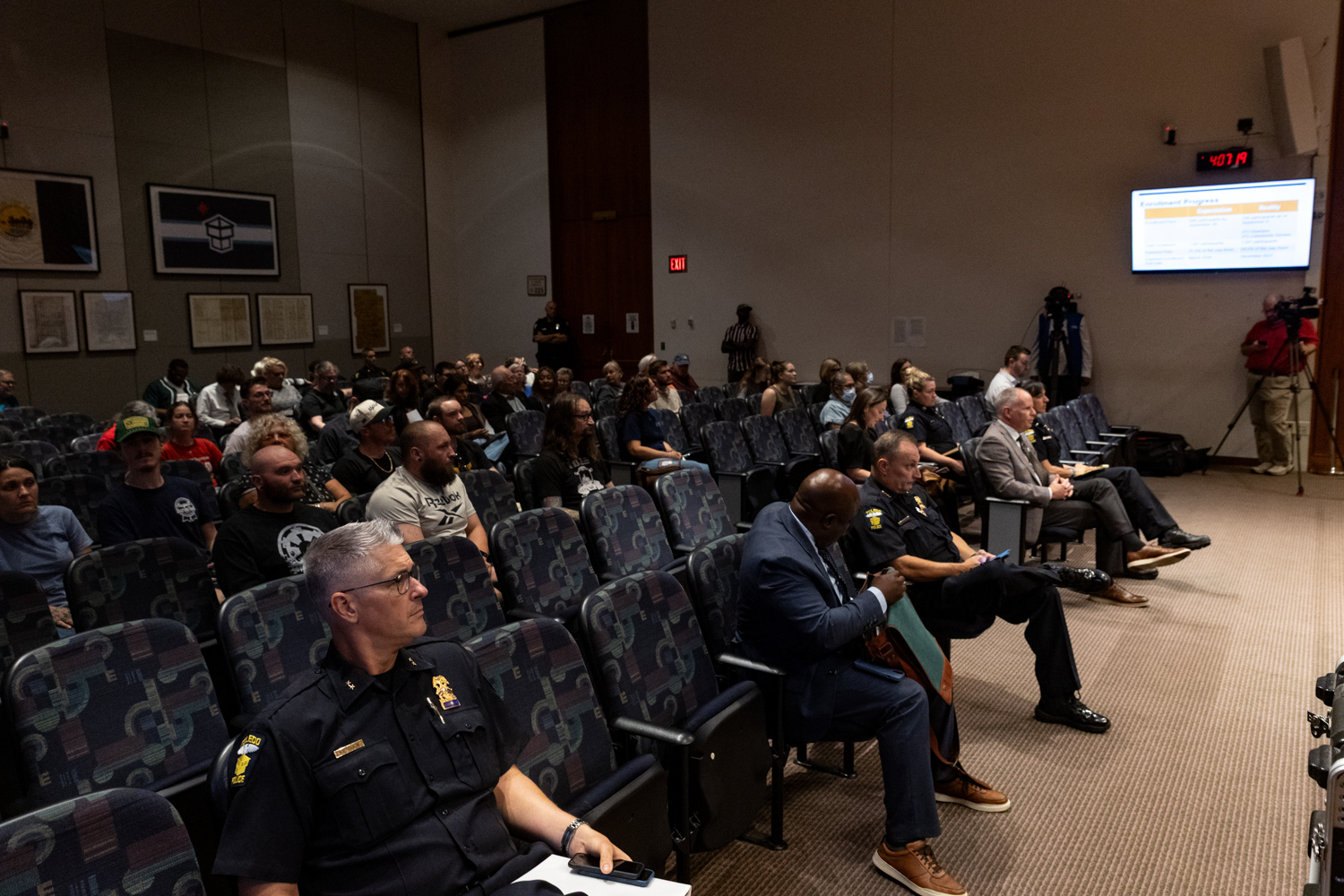
In full, the meeting spanned roughly three hours and 20 minutes, causing many attendees to accuse council of “filibustering” against the public comment for the first two hours of the meeting.
Generally, council interacts with a panel, giving their expertise, and public comment comes afterwards. However, the time taken by council to hear from ranking police and a judge left multiple members of the public disgruntled at the very least.
Most outspoken against how the meeting was conducted was local progressive organizer Sean Nestor, who spoke loudly as he communicated his dissatisfaction.
*Disclosure: Nestor is the board president of the Toledo Free Press.
“I come here offended,” he said. “I’m deeply offended at the way this council has handled this issue. You know that there are dozens of people waiting to speak today who have waited two hours through a filibuster that is essentially a public relations effort…”
Nestor accused the council of using the time before public comment to change the minds of those in attendance to be in favor of the Flock system.
Nestor leaves the podium after criticizing Flock Group, Inc.’s ALPRs and City Council’s approach to leaving room for public comment. (TFP photo by Stephen Zenner)
The chair of the committee, Councilman John Hobbs III, District 1, was also scrutinized for some of his opening remarks before the discussion about the Flock ALPR cameras.
“I want to say before we start this meeting tonight…We did not have to have this discussion at all,” he said. “But I wanted to have a discussion where we can have a public meeting where we can talk about this issue, talk from both sides [to] those that are for and those that are against.”
This tone and perspective seemed to be an attempt to maintain order and respect during the meeting, but was received by some of the public as condescending.
“I appreciate the time to talk today. Although, like Sean said, it is actually really offensive to say, ‘We didn’t have to have this public hearing.’ It just doesn’t sit well with constituents,” said Jessica Molina, a local advocate for immigrants, when she started her public comment.
Jessica Molina, a local activist with Abriendo Puertas para Soluciones (APPS), speaks about the effects of Flock Group, Inc.’s automatic license plate reader cameras (ALPRs) on the immigrant community in northwest Ohio. (TFP photo by Stephen Zenner)
Two new Flock items
Adding a year
Public comment on the Flock system was previously fielded on June 22 after a vote failed to pass funding through O-240-26 – $14,000 annually for TPD’s Real Time Crime Center (RTCC) – for two years.
Just days after the original ordinance for that funding failed, another ordinance was drafted, O-286-26, an ordinance that specified funding for one year as opposed to the annual renewal outlined in the first ordinance.
On the June 23, O-286-26 passed funding for one year, and now the Flock discussion is fielding comment on extending funding for the RTCC for another year. This would make O-286-26 identical to O-240-26, which failed, mainly due to a lack of Flock supporting council members present for the vote. All who voted against Flock for O-240-26 were in attendance for the O-286-26 vote, but were outnumbered when more council members were present.
John Hobbs III, the chair of the Public Safety & Criminal Justice Reform Committee and Toledo City Council representative for District 1. (TFP photo by Stephen Zenner)
Expanding into District 2
The other issue debated at the committee meeting was an expansion of Flock cameras into District 2, at the request of Martinez, Toledo city councilman for District 2.
A brief to the committee describes the proposed ordinance, O-307-26: “This project will purchase cameras, gateway system to give TPD access to camera footage at partner schools and pay for first year of subscription.” $85,000 was requested in the ordinance for 16 locations, and the ordinance notes that schools do not have to participate if they did not want to.
Martinez, Toledo City Council Chief of Staff and Council President Proxy Lucy Frank, and Director of Economic Development Brandon Selhorst were all named as contributing planners to the initiative, which seeks to prevent school shootings.
The brief to the committee explained that “locations for cameras included a review of where crime is most prevalent, types of schools and spaces, and what was already in use at that school, including camera blind areas. The Flock cameras will go around high school football fields with large athletic events.”
Unfortunately, Martinez only explained his proposed ordinance in the last ten minutes of the three-hour-and-20-minute meeting. Much of the earlier comment and panel discussions functioned as a broader support or criticism for the Flock system as a whole, instead of the specific additions proposed in O-307-26.
“We’ve had three major murders in the last eight months,” Martinez said, explaining his thinking behind the ordinance. “I have an eight and 10-year-old now, and I am very concerned about their safety…District 2 has the least amount of cameras in the entire city of Toledo” at 37 cameras.
Specifically, Martinez pointed to added cameras at Rogers High School, Bowsher Stadium (not Bowsher High School) and “gaps in our coverage where individuals can go in and out of different municipalities…” Cameras would only be activated with a 911 call, according to Martinez, and their main purpose would be to improve emergency response times for first responders.
The $85,000 covers the first year of hardware/software installation, as well as the first year subscription fee.
Certain schools have chosen to be a part of this initiative, and Martinez said those schools could opt out after the first year. Going forward, after the first year, schools would be responsible for the subscription fee, and because it is from the capital improvement fund, Martinez said the contract had to be for five years.
“Any funds that aren’t used will go back into the District 2 DIP [District Improvement Program] allocation,” he said.
Kevin Braun, assistant Toledo Police chief. (TFP photo by Stephen Zenner)
District 2 expansion comment
Only two of the many people with public comment specifically addressed O-307-26: Molina and Nestor.
“We reached out to every single organization and school that was listed as a partner. They are not publicly committed to being partners, none of them,” Molina said, and criticized an earlier meeting where the ordinance was discussed with a similar format – two hours followed by comments.
At the time of publication, the Toledo Free Press was not able to independently verify either Molina or Martinez’s claims about open cooperation with the camera expansion into District 2.
“I’m offended that earlier today, when these law enforcement officials talked about this, they downplayed the reality that part of Martinez’s proposal is the introduction of more PTZ [Pan, Tilt, Zoom] cameras, which are not just monitoring vehicles; they are monitoring people,” Nestor said as a direct criticism of Martinez’s proposal.
Given the nature of Martinez’s initiative to curb school shootings, the introduction of the PTZ camera, designed to monitor individuals, makes sense, although it raises further questions about surveillance.
During her overview of the Flock system, Lieutenant Leslie Cook, a Toledo police officer who works extensively with the Flock system, explained “live view cameras.”
“We have three live view cameras. I think this is where some of the additional concerns may come up when people talk about cameras tracking people’s movements,” she said. All three of these cameras are positioned at intersections and have ALPR functions, but she assured those in attendance that the mode that tracks movement, human or otherwise, is kept “off at all times.”
Cook added that part of keeping the movement tracking mode “off” is because the cameras are positioned at intersections, and would not be effective for monitoring with so much movement.
No information was given on how live view cameras might be implemented in coordination with D2 schools or the areas described in O-307-26.
Lieutenant Leslie Cook. (TFP photo by Stephen Zenner)
Panel
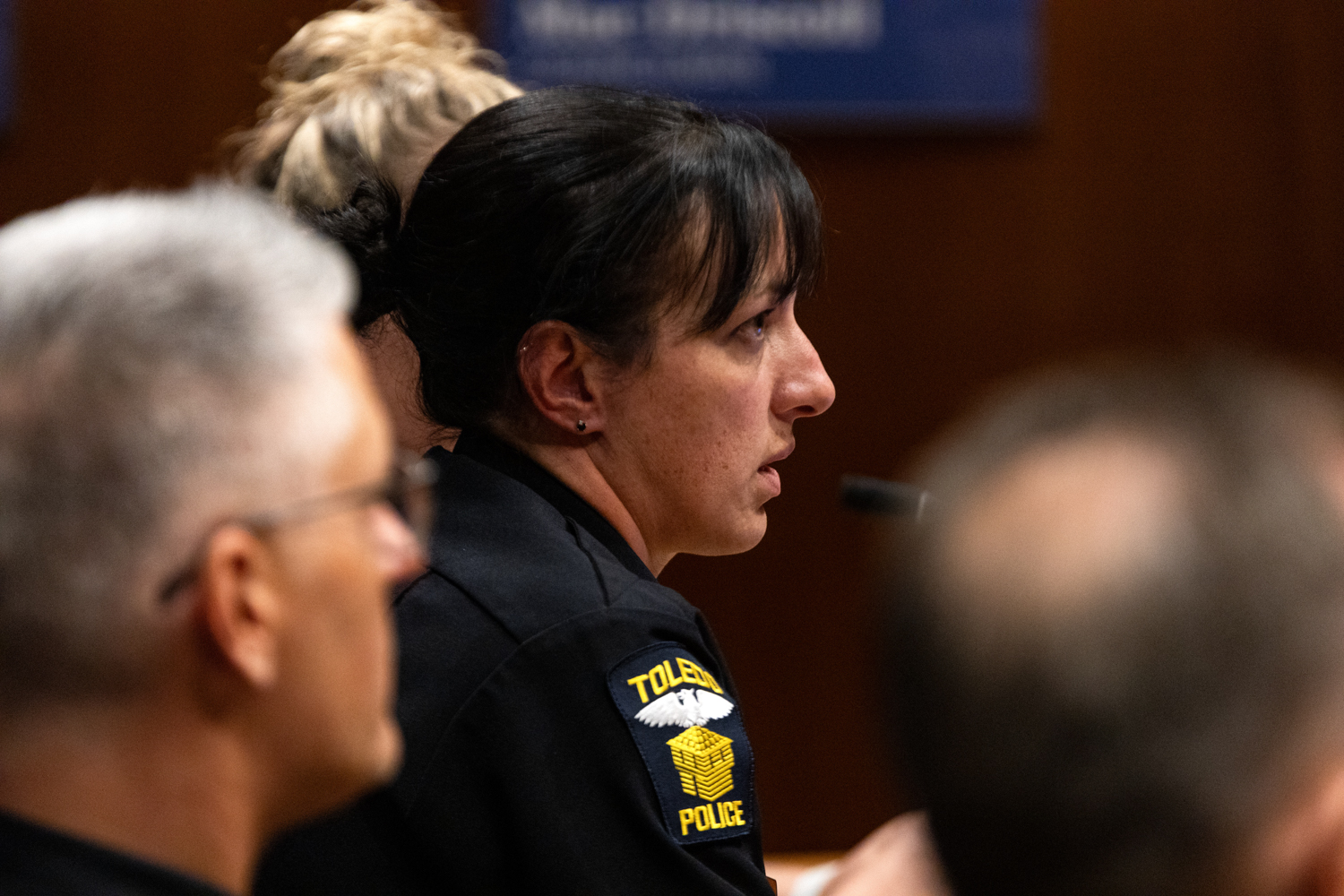
More broadly, Toledo City Council members addressed their comments and concerns in front of the public to a police panel, which included Police Chief Michael Troendle, Assistant Chief Kevin Braun, Lieutenant Cook and Captain Kellie Lenhardt.
Before questions were asked, Troendle explained his hopes in addressing the council and public: to help people understand the effectiveness of the Flock system in solving crimes, to dispel any misinformation about how the system works and create trust between the police and the public through showing safeguards in the Flock system.
He ultimately said that disbanding the Flock system would be “a shot against our own community. We’ll have more victims. We’ll have more victims that don’t get justice because we’re unable to arrest the perpetrators.”
Braun then shared anecdotal cases where Flock had been helpful in locating missing persons and solving homicides, noting the clearance/solve rate for homicides since the use of Flock began in 2022.
Braun said that in 2021, before Flock was implemented, the clearance rate for homicides was 59 percent, near the national average of 61 percent. He reported that 2024 had an 87 percent clearance rate for homicides. Just last year, TPD had an 81 percent clearance rate for homicide. Braun did not say what 2022 or 2023’s rates were.
Braun also shared the process of searching the Flock system. “When the database is searched, we receive a photo of the vehicle, a photo of the license plate, and the time and location that the photo was taken. That’s it.
“The overwhelming majority of images captured by the system are never viewed by a police officer. They remain in the system during the retention period [30 days] and are ultimately deleted without ever becoming part of an investigation,” he said, and later Cook would confirm that a maximum of 0.4 percent of images taken are viewed.
“Officers who have access to sensitive investigative systems should absolutely be accountable for how they use them. We agree with those principles,” Braun added before leaving it to Cook to explain more.
Braun speaks with Vanice Williams, president of Toledo City Council, vice chair of the Public Safety & Criminal Justice Reform Committee and Representative for District 4, before the meeting. (TFP photo by Stephen Zenner)
Access and searches of the network are always logged, according to Cook, and certain behavior is flagged for review if deemed suspicious by the system:
– If someone searches an individual 30 days after searching them
– Only searching outside of Toledo
– Searching the same plate with multiple case numbers
– If only one person searches a plate and does so more than 10 times
– Certain time windows for searches could also flag a search
These flags are manually reviewed by ranking police officers, Cook said.
TPD shares Flock data with 2,235 organizations, 437 of which are in Ohio. 1,283 of those organizations are sharing their data with TPD, 371 of which are in the state of Ohio.
Federal sharing is turned off, so federal agencies cannot request TPD’s data. Immigration and reproductive care searches have been turned off in TPD’s Flock system, meaning TPD cannot search for those subjects explicitly, and Toledo’s cameras cannot be used explicitly for those kinds of searches.
“They’re searching the entire United States. They’re doing a lookup on their plate to see where their plate has gone, and very rarely is that plate here in Toledo,” she said.
Hobbs begins the discussion around Flock’s ALPRs with an assembled panel of ranking Toledo Police including: (left to right) Captain Kellie Lenhardt, Lieutenant Leslie Cook, Assistant Police Chief Kevin Braun and Police Chief Michael Troendle. (TFP photo by Stephen Zenner)
Council’s questions
Driscoll
When estimating TPD’s searches in reply to a question from Driscoll, Cook said a month yields roughly 22,000 searches from TPD. However, Cook mentioned that refreshing a computer page could read as another search inside the Flock system, skewing the numbers higher than they actually are.
Driscoll asked if TPD was independently auditing the Flock system, or if they were relying on the Flock system to flag individuals and search for abuse.
Cook said TPD did not have an independent audit structure at the time of the hearing.
“Does it flag suspicious searches from other communities?” Driscoll asked, and Cook said the system does not flag suspicious outside searches for review.
Towards the end of his questions, Driscoll asked for a list of all the ways Flock has been useful in police work and how.
Braun said he would love to provide cases where Flock has been helpful. Cook said there are examples on the transparency page, but Troendle said the specifics of how Flock was used in each case are not logged.
“We don’t keep a log that we say, ‘Hey, every time you use this, please go into the spreadsheet and tell us you used it’ because that would actually then take a lot of work from the officers,” Troendle said and stressed the amount of work police do. Troendle then encouraged all council members to come see how Flock works in real time with TPD.
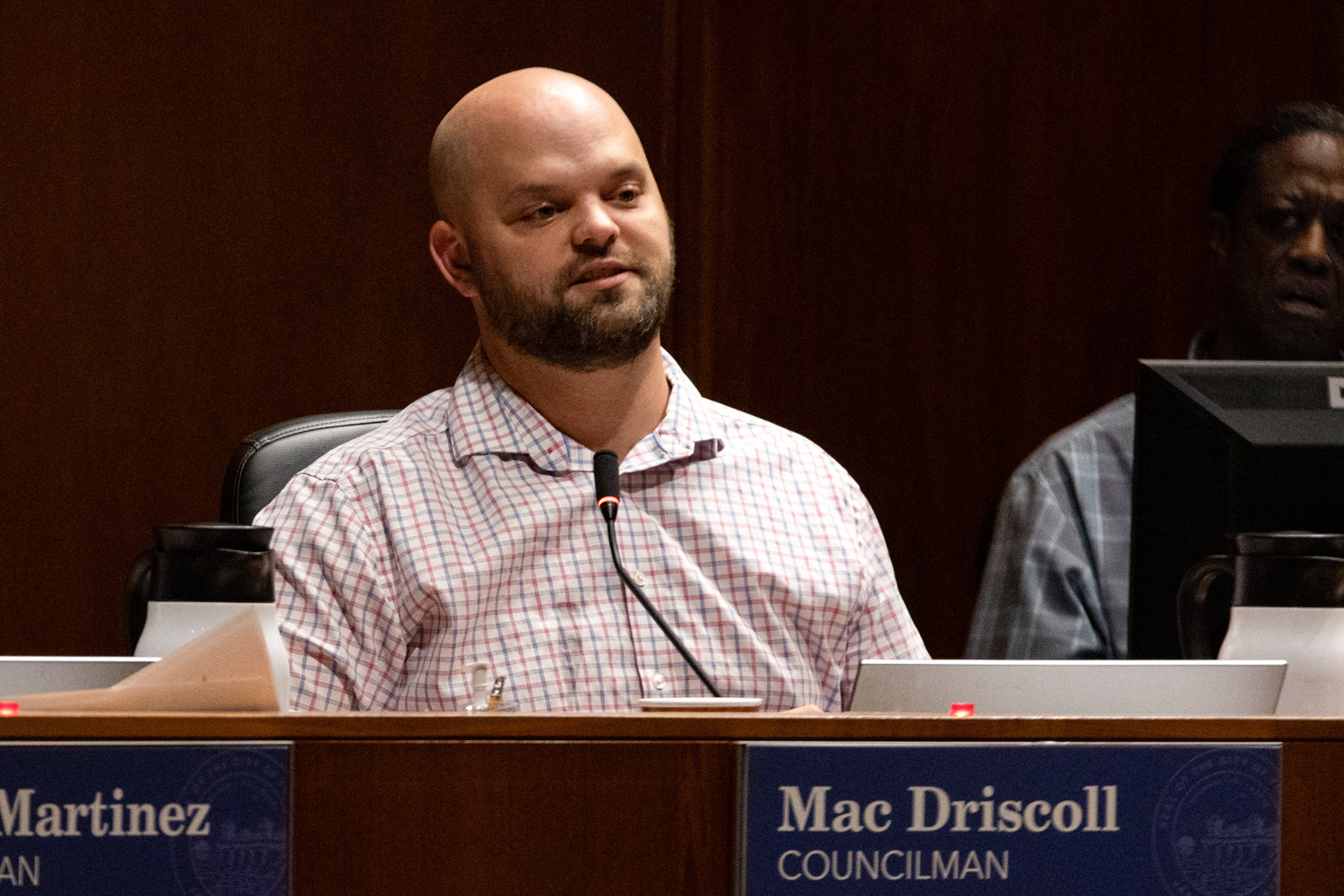
Mac Driscoll, Toledo City Councilman At-Large. (TFP photo by Stephen Zenner)
Driscoll then asked if TPD had any instances of Flock misuse.
“At this time, we are not aware of any misuses,” Troendle said.
After his inquiry, Driscoll was unsure of where he stood exactly with Flock.
“Look, you can weed your garden bed by setting it on fire, and you’re going to kill all the weeds. But is that too imprecise of an action?” he asked. “We’re collecting all this data. We don’t really have control of it…I’m not sure we can necessarily guarantee the safety of it in light of this. I want to know for a fact that those people’s data is not accessible from a third party, and I’m not quite sure on that.
“I do feel we should pause our Flock system,” he said, at least until better regulations for AI are available. Then he ended his questions and resolution saying he fully supported TPD.
Gadus
During the first Flock hearing, District 3’s council representative, Theresa Gadus, had a long list of questions for the public relations director from Flock.
But this time around Gadus was brief.
“What they share with you [TPD] is not what they’re collecting, and there’s a dissonance in there that I think is part of where I share the concern of what it means to be mass surveilled,” she said.
On July 1, Gadus said she put in a 10-point public records request concerning Flock to TPD. “That was 78 days ago,” she said. “I still haven’t gotten any information.”
When explaining that she didn’t need to see all records on Flock, Gadus said she could have looked over just one month’s worth of information to help inform her constituents.
“I could have seen June, I could have seen July, I could have seen August. I could have given information that my district is asking for, redacted, safe and I could have answered questions for them, but because I haven’t received anything in 78 days, it’s very difficult for me to do my job.”
Visibly frustrated in her final statements, Gadus said, “The people that I govern for right now have a lot of questions, and they want this paused, and they they do not want to be mass surveilled.”
Theresa Gadus, Toledo City Council Member representing District 3, talks about information transparency from Flock’s ALPRs. (TFP photo by Stephen Zenner)
Sarantou
Delving into repercussions, Councilman At-Large George Sarantou wanted to be clear on the penalties for abusing the system, which was the one question he asked the panel.
Officers could end up losing their jobs and, depending on the abuse, face prosecution for abuse of the system.
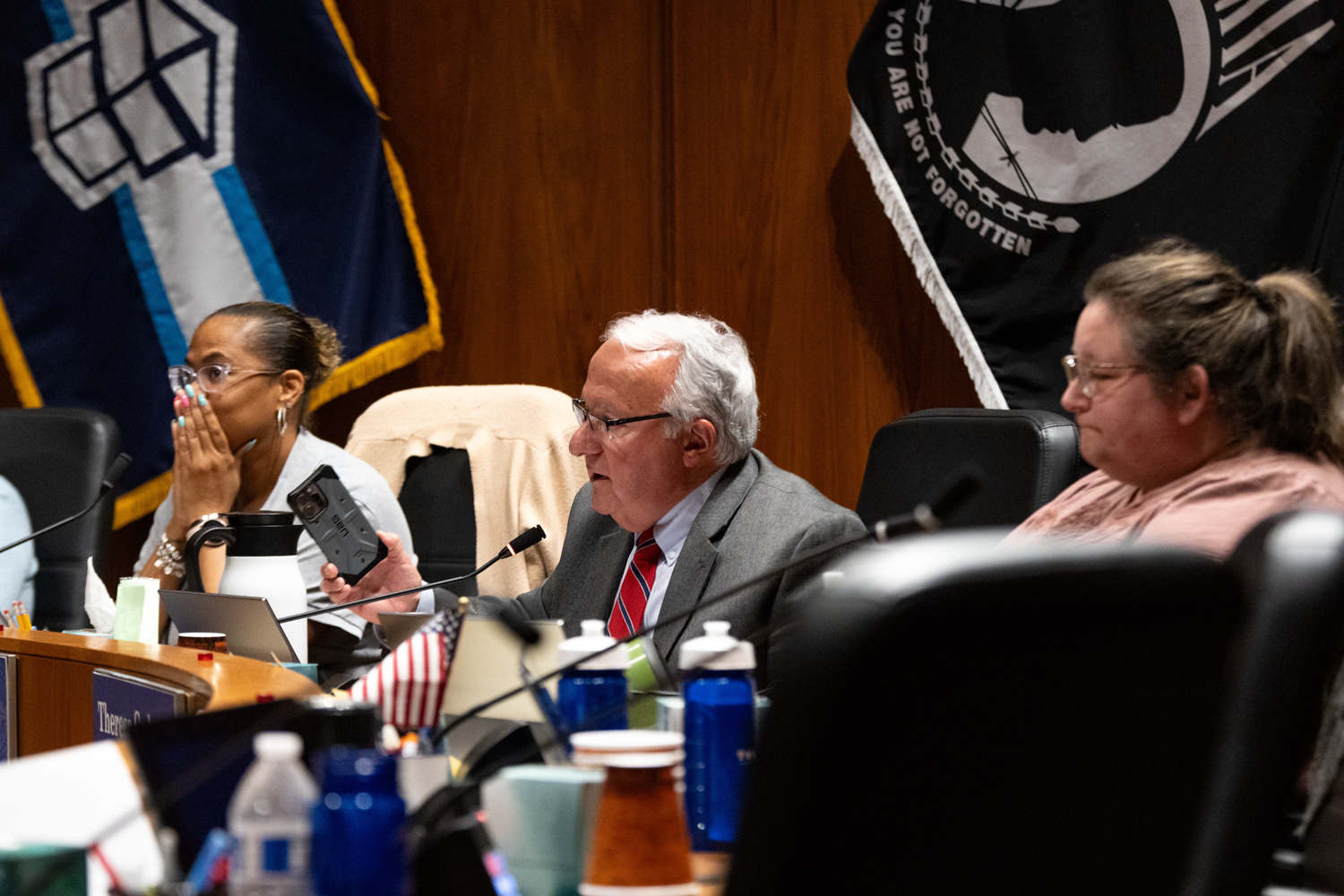
Sarantou then equated the privacy given up by using cell phones and the internet with going out into the public.
“I just think that it’s unfortunate [the loss of privacy], but we’ve also seen a tremendous amount of crimes solved, and we’ve seen bad actors apprehended as a result of that and brought to justice,” he said.
“I hear a lot about privacy concerns. What about the victims of crime? Don’t the victims have rights?”
With that, Sarantou yielded his time.
George Sarantou, Toledo City Councilman At-Large, talks about cell phones compromising privacy. (TFP photo by Stephen Zenner)
Kramer
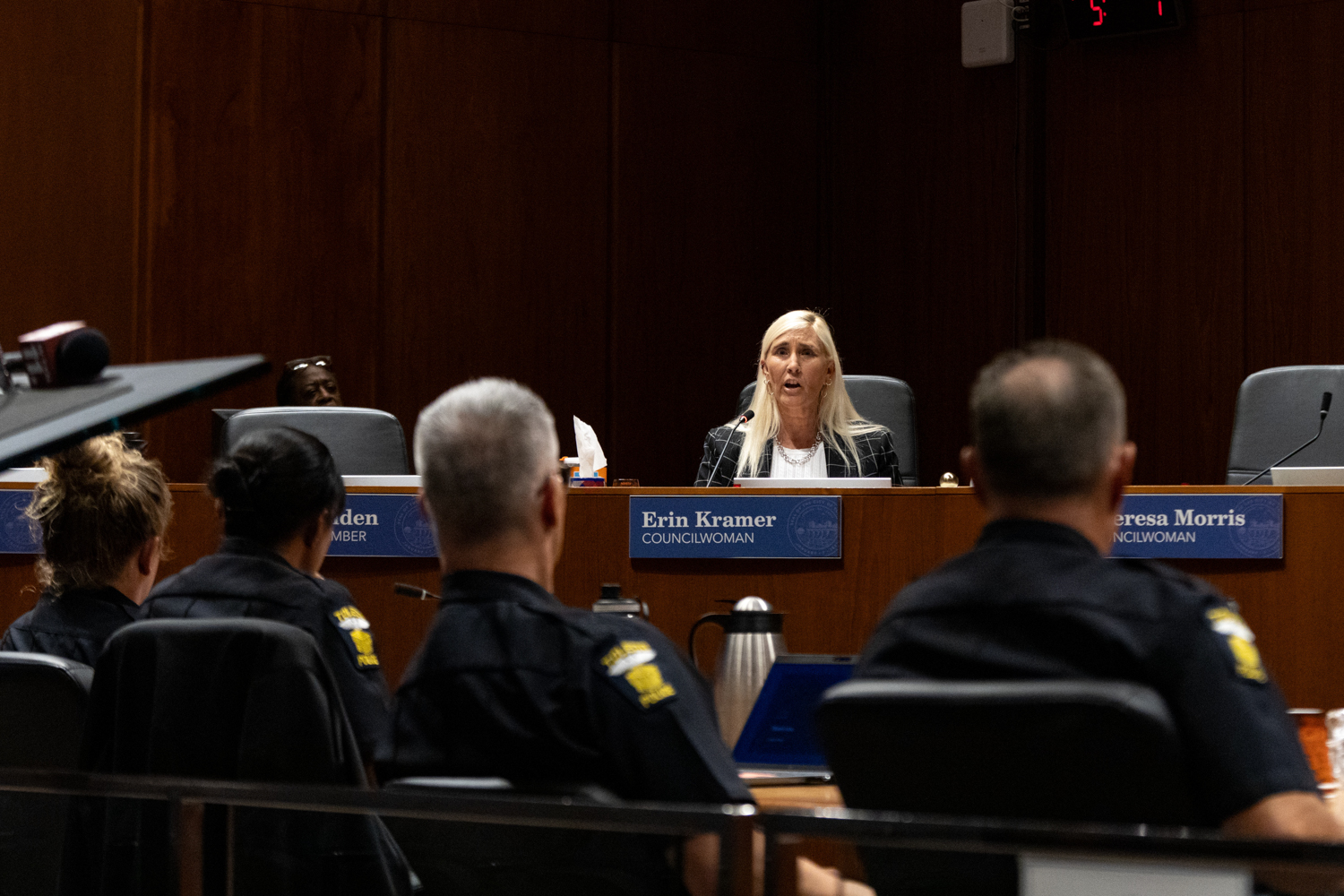
“We should have oversight if we are going to be passing this over and over again, giving the police department money for this system. We should have oversight,” said Erin Kramer, council member at-large, echoing Gadus’ complaint and trying to keep her questions and comment brief.
“I’ve looked at the transparency page; it’s not very transparent. I don’t get a lot of information from looking at that, so that is my concern,” she said, and then asked if more cameras in D2 would deter a school shooting.
Troendle could not say it would deter a shooting, but said it would help police do their job better.
In response to Sarantou having read an email from a supporter of Flock, she said, “We have all received hundreds of emails that oppose those Flock cameras,” and ended her time speaking.
Erin Kramer, Toledo City Councilwoman At-Large. (TFP photo by Stephen Zenner)
Williams
“I just want to say, as the district that has the most license plate readers and cameras, I am in support of them,” saidWilliams, vice chair of the Public Safety & Criminal Justice Reform Committee, president of Council and representative for District 4.
“District 4 is the highest crime area in the city of Toledo. That crime has decreased significantly, and crimes have been solved faster. The quality of life in our neighborhoods in District 4 has been better over the years that I’ve been on Council. In conjunction with me a couple years ago purchasing two Flock cameras, this discussion didn’t come out.”
Williams then revealed she had purchased the cameras to decrease crime in the Greenbelt Apartments on the other side of Cherry Street, and dared her colleagues to walk over there with her.
The council president then pointed to an instance of an 8-month-old who was killed, and Joseph Johnson, 16, who was murdered, and whose murder was solved with surveillance cameras.
“I will not advocate for a pause when I have a baby dying and a 16-year-old dying,” she said. “We are doing an audit. Once that audit comes back, if we find out it’s a mess, we’ll take action from there.”
Martinez
Without going over the specifics of his ordinance, Martinez began asking questions about Flock in a broad view. “Everyone is at a heightened awareness now because of the abuse that we’re seeing at the federal level on technology into our residents,” he said, and then asked his first question.
“Is there a way for ICE to utilize TPD?”
Troendle answered that “there is no legal way for them to access our system.”
Martinez also asked, “Other federal agencies that do not have our sharing permissions, how would they access information for whatever reason?”
The FBI, DEA and ATF have working relationships with TPD, Troendle said, “So, depending on what they’re looking for, as long as it doesn’t violate any of our policies or anything else like that, and it’s a legitimate law enforcement purpose, and usually specifically that impacts the City of Toledo, then we do share information with them.”
Martinez then invited Judge Lindsay Navarre to speak on her interactions with Flock, where she lauded the successes of the system as effective for fighting crime, naming individual volatile cases where the system was used to solve heinous crimes.
Weighing-in from a legal perspective, she said, “There is no reasonable expectation of privacy in a license plate on a public roadway, and I do think there is an important distinction to be made between mass surveillance of people and the use of a vehicle-based investigative tool after a crime has occurred.”
It is likely Navarre is referring to a year-old case, Commonwealth v. Church (Va. Ct. App., decided Oct. 14, 2025), where a federal judge ruled a warrant was not necessary to use the Flock ALPR system.
While this indicates the courts are leaning towards the Flock system being legal, there is still debate, and it is likely this will not be settled case law without a ruling from the Supreme Court.
A small back-and-forth exchange occurred after Navarre’s time, where Gadus brought up Brandon Upchurch, who was wrongly flagged by Flock and bitten by a police dog. The city was forced to pay $35,000 to settle the lawsuit.
The Public’s comment
Arnold
First to speak was a regular to city hall meetings, Richard Arnold. During his first public comment at a previous meeting, Arnold had begged Council not to muddy the waters around Flock, and make a firm decision, so as not to decrease public trust.
This time, Arnold begged Council not to make a “rash” decision, and to simply go through with an audit, and deal with things from there.
“Any termination or disruption that would be a rash decision, and I don’t think that would be in the best interest of the city’s safety,” he said.
Flahiff
A Point Place resident, Janice Flahiff, politely spoke against Flock cameras.
“With all due respect, Flock cameras are not like cell phones or going into stores. When it comes to privacy, we choose to have cell phones. We choose to go into stores. We do not choose to be monitored by the state without legal and constitutional justification.”
Flahiff then said Flock cameras were unconstitutional, more so than red light or speed cameras, because they track movements, beyond a singular point in time.
“At the very least,” she recommended the necessity of a judicial warrant to access the Flock database. “It’s really not about solving crimes or finding missing people…It’s all about what kind of surveillance is constitutional. Flock cameras are against our Fourth Amendment rights.”
Dorn
John Dorn said he thought some of the arguments made by police and Council were “disingenuous,” and that he was concerned about police abuses of the system.
He made the point that, when putting information in for an investigation, an officer could put any reason in for a search, and he called the ALPRs “facial recognition for the vehicles.”
In opposition to the proposed expansion he said, “This is for additional license plate readers – Flock cameras. Toledo already has Flock cameras. Okay?”
Viofranco
“I’m speaking on behalf of Abriendo Puertas para Soluciones (APPS) and Privacy First,” said Paul Viofranco, who thought Flock cameras set a “dangerous precedent” of guilty until proven innocent.
Quickly moving past smaller criticisms he had with lack of transparency, the lack of oversight and the lack of “guardrails” or coherent AI policy, Viofranco chose to focus on investment. Funding for afterschool programs, job training, food security, drinkable water, mental health services and community policing, he said, were all investments in the community of Toledo.
“Investing in surveillance technology that enriches the cynical corporation is not security,” he said, and was given a generous amount of applause upon finishing his thoughts.
Garcia
“Voting to extend a one-year extension to allow the use of these cameras, you’re showing us that you’re siding with the agencies that use the cameras, not with the community that have concerns,” said Enrique Garcia. “We’ve seen many mistakes in the country. We can’t have any of these mistakes here in Toledo.”
Then Garcia expanded on the totality of the camera surveillance tracking audio, video and movements, and accused the council members of not fully understanding the technology.
Kuehn
On behalf of the Northwest Ohio Peace Coalition, Susan Kuehn, read a prepared statement that brought tears to her eyes.
“We strongly oppose Council Member Martinez’s proposed ordinance for the expansion of Flock’s surveillance license plate readers and pan-tilt cameras in District Two’s intersections and on school campuses,” she said.
Flock, she said, violates the Fourth Amendment of the Constitution of the United States.
“If this ill-conceived ordinance proposal at issue today is allowed to move forward in this committee, it will prove to be an irreputable betrayal of Toledo’s immigrant communities, and a severe breach of Toledo Ordinance O-095-26…” an ordinance designed to separate Toledo’s resources from Immigration Customs Enforcement (ICE).
“TPD shares its Flock camera data with 269 jurisdictions across the country, involving 27 states that have 287G agreements with ICE, effectively creating a functional side door, back door, for federal immigration enforcement to track and locate members of our Toledo immigrant community,” she said, tearing up.
287G agreements allow local law enforcement to help in immigration enforcement on behalf of the Department of Homeland Security.
“This means routine driving, even in a city with welcoming local policies, carries a continuous risk of automated detection by an interconnected statewide and national network of ICE deputized local police,” Kuehn said, and accused TPD of being in violation of O-095-26, before being cut off from speaking further.
Susan Kuehn, a representative for the Northwest Ohio Peace Coalition, finishes reading a prepared statement against Flock Group, Inc.’s ALPR cameras.
Velasquez
“I represent the other FLOC,” said Baldemar Velasquez, the founder and president of the Farm Labor Organizing Committee (FLOC). Velasquez recommended outlawing Flock cameras outright, because, “the benefits don’t outweigh the risks.”
“I appreciate the local law enforcement. Since 2017 we signed a code of conduct,” he said, to increase the rapport with local law enforcement and help them solve crimes.
“We have 189 families that are associate members that got mixed immigration status in the city, and they are worried,” Velasquez said. “We have heard reports here from access to this data from national law enforcement agencies that are running roughshod over our constitution.”
Referring to DHS, the FBI and CIA, he said, “You don’t think they can get into the information of these Flock cameras?”
Previously, Velasquez said the agreement with law enforcement allowed his community to teach its people to respect and work with the police, but he said they expect the same in return.
Baldemar Velásquez, the president and founder of the Farm Labor Organizing Committee (FLOC), addresses Toledo Police during the meeting. (TFP photo by Stephen Zenner)
Nestor
Perhaps the most fiery speaker in the public comment section, Nestor immediately said he was speaking against the Flock proposals, and chastised the council for forcing the public to wait two hours to give public comment.
“I’m offended at the way there is constant misrepresentation of the concerns…There is a federal government that is deciding what crime is,” he said.
“That quorum is saying that if you overstay a visa, if you look like an immigrant, we will hunt you down. We will break open your door without a warrant. We will throw you in the streets. We will throw you in incarceration without representation. We will move you across this country. We will torture you, and in some cases, we will murder you in the streets. That is happening. That is reality. That is not misinformation.”
Nestor accused the council of “handpick[ing]” the choices for government, misrepresenting concerns and ignoring constituents, and told the council they needed to do some deep “soul searching.”
After the heated rebuke, the room erupted in applause.
Local activist Sean Nestor criticizes Flock Group, Inc.’s automatic license plate readers (ALPRs) and the way the public comment was characterized by some council members. Nestor’s main frustration was that the public had to wait two hour to speak their mind on the ALPRs. (TFP photo by Stephen Zenner)
Pritchard
Following Nestor was a woman named Alison Pritchard who identified herself as part of APPS, Toledo’s advisory audit committee, and as a certified internal auditor.
“This is not a one-and-done activity. Strong governance requires regular, ongoing, and frequent controls and independent audits,” she said. “This is particularly critical for any schools that may be using this technology, given the risk to minors.”
Furthermore, Pritchard said as an auditor, vendor-developed filters or audits fall short of independent evaluations of the system.
Pritchard accused the council of shirking their responsibilities by potentially leaving communities open to risk.
Covarrubias
Belinda Covarrubias took to the podium, and introduced herself “as Hub Director of the Centro Hub, a member of APPS, and the proud daughter of immigrant parents.”
Immediately she cited O-095-26, the same ordinance referenced by Kuehn, and began to quote it. “No department employee, public official, or public servant of the City of Toledo shall use city monies, equipment, or personnel for the sole purpose of detecting or apprehending any person based on the person’s suspected immigrant status.”
When O-095-26 passed, it was done unanimously, and Covarrubias reminded the council of their promise to defend the people of Toledo. She pointed out that through the Flock system, 269 jurisdictions across 27 states have 287G agreements with ICE.
“You cannot put limits on data that you cannot hold,” Covarrubias said, and pointed to Dayton, Columbus and other Ohio areas who had stopped or paused using Flock because they could not control where the data went.
In light of the insecurity of the data, she urged Council to keep their promise, cease expanding Flock, pause the use of Flock and cancel contracts with “mass surveillance” companies.
Molina
Molina took the podium next, telling Hobbs it was offensive that he said the council didn’t have to hear from the public and then told Williams, “You don’t understand our plight. Our fathers with legitimate visas are being arrested, detained, deported by the local law enforcement in this city.”
“In March, we were grateful that the ordinance [O-095-26] passed. In May, we came back with concerns,” she said. “Please pause the Flock surveillance. Please conduct an audit. Just reassure us that that you’re not violating the ordinance.”
Molina referenced the 287G jurisdictions with access to TPD’s Flock data, and she referenced Cook’s admission during the panel that TPD is not able to audit outside organizations using the Flock audit tools. By putting these two pieces of information together, Molina concluded that an independent audit was necessary to reestablish trust, and assure her community that outside organizations were not using Flock against immigrants in Toledo.
She ended her time by opposing the expansion of Flock into D2, and said no schools publicly wanted to partner with the Flock expansion.
Rios
Anita Rios introduced herself as a lifelong Toledoan and addressed President Williams.
“I live in your district, Vanice,” she said, and shared that she lived a block away from where the Old West End Festival shooting took place earlier this year.
“I’m not safer in my house that I have lived in for 30 years. I’m not safer now because of those cameras,” Rios said. “Maybe if somebody kills me or shoots me, they’ll be able to catch the person, but I’ll still be dead.”
The longtime Toledoan called the Flock cameras “an illusion of a solution,” which received applause. “We live in the United States of America. That’s supposed to mean something,” she said and added that it means liberty and freedom.
Rios said to Councilman Hobbs, “You really didn’t have an option but to do this [hold public comment on Flock], and maybe you think you didn’t have to do this, but you did.” And then she reminded him that, “…it’s only meaningful that you sit in those positions if you listen to us as your constituents and you do the right thing.”
Anita Rios, speaks against Flock Group, Inc.’s ALPRs. (TFP photo by Stephen Zenner)
Daly-Masternak
Railing against billionaires, and quoting George Orwell’s 1984, Peggy Daly-Masternak spoke of the prevalence of surveillance in the 21st century and how it has not made life safer.
“’It was terribly dangerous to let your thoughts wander when you were in any public place or within range of a telescreen. Big Brother is watching you,’” she read from the novel, and spoke about baby monitors, Alexa and Meta Glasses to drive home the point that surveillance is everywhere.
“Every one of these surveillances will likely be justified by someone,” and then she pointed to school shootings, porch pirates and retail theft to show the surveillance did not stop crime.
Daly-Masternak ended her time saying liberty dies by 1,000 cuts, not by one edict.
Gray
A young Oregon, Ohio resident with a degree in computer science and engineering, Austin Gray presented information on his community’s 11 Flock cameras.
“I’ve been conducting my own audit of Oregon,” he said. “I just wanted to come up here and say that today I submitted my own FOIA (Freedom of Information Act) request to the City of Toledo [which he had not heard back from]. Oregon got back to me in five days. That’s a lot better than 78 days.”
Over the course of a year, Gray said 8,515,574 searches had been performed by 5,036 different organizations across the cameras in Oregon.
Then Gray listed the top organizations that accessed those cameras. “The U.S. Postal Service is at number one at 39,000 [searches]. The FBI is at number two at 36,000 and ICE is at third with 3,700.”
“I really didn’t expect this,” he said, and offered to go over the data with any council members, even though they did not directly represent him as a resident of Oregon. He then thanked the council for letting him speak.
Austin Gray, a resident of Oregon, Ohio, shares that he was able to get Flock Group, Inc. information from the city of Oregon within a week. (TFP photo by Stephen Zenner)
Gedert
Toledo’s own food truck drag queen, David Gedert (Sugar Vermonte) said the first two hours of the meeting was Flock PR, and pointed out that Flock cameras have people tracking capabilities.
“Any system that can track or search by bumper sticker is a system that can track or search by belief,” he said.
Citing Supreme Court cases in support of privacy, Gedert listed off the years 1928, 1958, and 2021.
“Justice Brandeis said that the right to be left alone was the chief and most fundamental of American rights,” he said, referencing an article from Supreme Court Justice Louis Brandeis in 1890 and subsequently from a dissenting opinion from Brandeis on Olmstead v. United States (1928). The Supreme Court ruled in a 5-4 ruling that wiretapping did not violate the fourth and fifth amendment of the United States Constitution.
The 1958 court case Gedert referred to was when the court upheld in NAACP v. Alabama that the NAACP did not need to disclose its members list, and Gedert said what was happening then and now was tracking through association.
“The basic argument that I heard presented was ‘trust us,’ and let me say, I do trust you. I do trust law enforcement to solve crimes the old-fashioned way,” he said. “This was not voted on, and you do not have the consent of the governed.”
Gedert threatened a ballot initiative to stop Flock cameras if Council did not listen, and left the podium with a hair flip and applause.
David Gedert, local food truck owner and drag queen (Sugar Vermonte). (TFP photo by Stephen Zenner)
Morris
Maurice Morris then addressed Judge Navarre.
“What she failed to mention – the United States Supreme Court has recognized the modern surveillance technology can create significant privacy concerns in Carpenter v. The United States,” he said, citing the 2018 case dealing with locating suspects by using cell phone tower data.
The court ruled police using cell phone location data violated the reasonable expectation of privacy.
“City council should take seriously the constitutionality and the privacy implications of creating a database capable of documenting people’s movement,” Morris said.
With the phrase “Search and Delete” Morris made his point. “You need a search warrant if you’re going to find out anything about me…If you delete anything in a database, we can find it.”
Identifying himself as someone with forensic training he said, “If you delete something, you can bring it back,” and called for safeguards and transparency surrounding Flock.
Moss
A young man from Scott Park, Gavin Moss, gave a short comment.
“There is a lot of really punchy anecdotes,” he said, and criticized the arguments for Flock. “There is no discernible evidence for any kind of reduction in crime caused by Flock cameras in any area.”
Then he said, “About 1/3 of the Flock cameras in LA [Los Angeles] have been false positives,” and called for an audit and data-based decisions to be made concerning the cameras.
Vullhorst
Louis Vullhorst, said, “I just want to say it doesn’t seem like there’s a clear vision for what the city council has in terms of what they want Flock to be.” Vullhorst was confused by the comments that Flock was purely ALPR tech, and about its proposed expansion into D2 schools.
“Do we want Flock purely as a license plate reader, or do we want Flock as a way to help in surveillance situations?” he asked.
“At the end of the day, Flock is a technology company,” he said. “What they really want is people’s information.”
“Information is the actually valuable thing,” Vullhorst said, and didn’t think of Flock as good or bad. “They just want money, and that’s how they’re going to make their money.”
Rosales
Moss’ roommate, Joe Rosales, said, “Personally, I would rather this whole Flock business be gone.”
“I don’t want every place I drive being tracked by any department across the country,” he said, and admitted that he thought there was a good chance the cameras would stay up.
If they stay up, he advocates for strong ongoing oversight.
Haynes
Michael Haynes was one of the few voices among the public commenters who wasn’t against the use of Flock. “I represent the Toledo Police Patrolmen’s Association. This will probably go over like a lead balloon, but I’m actually kind of split both ways,” he said.
Haynes said his police side was strongly for the Flock cameras as an effective tool to fight crime, but he said this was weighed against his conspiracy theorist side.
“Is this just another piece in the cog?” he asked, and then answered, “Yeah.”
With a waning number of police officers, Haynes mentioned the need for technology to fill the gap pragmatically.
“If we get rid of Flock cameras, essentially we’ll be blowing us back into the Stone Age as police officers,” he said, and mentioned that law enforcement has to catch up to the new criminal methods employed.
Addressing Council, Haynes asked them to do their job, and make sure the technology wasn’t abused, and then said, “My law enforcement side says the Flock cameras are very good, and we should keep them.”
Layman
The last speaker was Mandy Layman.
“I am a victim of crime,” she said. “Part of what keeps me protected from the people that harmed me is my privacy, my right to privacy.”
Layman grew up in Lucas County’s foster care system, and was penalized and judged for who she was throughout her life.
“If these cameras are invading people’s private lives, tell me, what is it that’s going to protect them from being penalized for minor things?” she asked, and then said she had a problem with sharing data between jurisdictions when officers do not have authority across jurisdictions.
An audit on Flock
At the next Toledo City Council meeting on Sept. 22, the council voted unanimously to perform an independent audit of the Flock system.
“Auditor John Rivalsky is independent of the city and works for Toledo City Council.
Some of the other items Mr. Rivalsky could review as authorized by the legislation include:
● Searches performed by city personnel.
● Searches of the city’s Flock network or data by outside agencies.
● Network-sharing arrangements and controls governing access by outside agencies.
● Data-retention requirements.
● Policies, procedures, training, and other requirements governing use of the technology.
● Controls designed to identify unauthorized or inappropriate use.
● Compliance with the city’s policies.”
Kevin Beaulieu, a Lucas County resident, who attended the discussion about Flock Group, Inc.’s automatic license plate reader cameras (ALPRs). (TFP photo by Stephen Zenner)
Waterville Township Zoning Commission members listen to 17-year-old Madeline Jeffer (right) read statistics about the impact of electronic billboards on drivers during a September 21 meeting. Listening are zoning secretary Patty Ruper, members Jon Poponak, Cathy Vorst, Keith Moosman and Bill Burkett, trustee Toby Miller and commission member Bob Long. (AWFP photo by Karen Gerhardinger)
WATERVILLE TOWNSHIP – After listening to dozens of citizens share opposition to a proposed zoning language change to allow two electronic messaging center billboards along a two-mile stretch of US 24, the Waterville Township Zoning Commission recommended reducing the face size and height from what was originally proposed.
“People brought up some good points,” Commission Chair Keith Moosman said at the beginning of the Sept. 21 meeting, referring to an Aug. 31 public hearing and emailed comments he’s received over the past few weeks. “Lighting is my biggest thing, and size. It’s huge and would be one of the largest in the area.”
Commission members Bill Burkett and Jon Poponak agreed.
“I have no issue with the number of signs or setbacks, but I am concerned about the size and height that is being proposed,” Burkett said.
But Bob Long said he’s concerned about the light from any size sign disturbing the residents in the area, including those who will be moving into the three-story Waterville Loft senior apartments, which is directly across US 24 from the location where Dutch Road Storage owners Dan Bollin and Jim Moline want to erect an off premise sign.
Currently, the off-premise sign language mirrors that of almost every other township: maximum face size of 72 square feet and maximum height from the ground of 15 feet. But as the self-storage owners began looking at the nonrefundable $10,000 application fee to seek a variance for a larger size – a fee that Trustee Toby Miller said attorneys have described as ‘punitive’ – the township began looking at reworking its language regarding signs.
The county’s senior planner, Molly Maguire, recommended disapproval, calling them ‘visual blight’ and stating that the proposed change to a maximum 670 square feet and 35 feet in height didn’t fit in with the character of the township. The Lucas County Planning Commission approved the change anyway, and sent it back to the township for the Zoning Commission and then the Board of Trustees to hold their own public hearings and make a decision.
Over the past month, several residents have shared opposition to the sign, stating that it is out of character with the township and will cause distractions and light pollution.
All of that information was taken into consideration as the Zoning Commission members weighed whether to pass on to the trustees a recommendation to approve the larger size, disapprove or make changes. Burkett, Moosman and Poponak voted to reduce the face size to 300 square feet and the pole height to 25 feet.
Cathy Vorst abstained, citing personal reasons, and Long voted against the measure. Long said he’s concerned about the light from the sign disrupting residents’ peace, and noted that the area of the township which abuts US 24 includes an incline and curve – and adding a distracting sign would not be good for drivers.
If the trustees approve and the sign is erected, the owners would sell advertising for goods and services beyond just Dutch Road Storage, and also provide Amber Alerts, traffic news and other township information.
“I’m wondering how you go from having negative thoughts to moving it to the trustees,” said Tournament Drive resident Peggy Langevin after the vote. “What is the benefit to the community to have this sign. I get that it’s a benefit for the business, but for the community, what would be the benefit?”
Trustee Toby Miller, who was at the meeting, said he didn’t see the benefit, but the key is to balance the property owners’ rights with the desires of the community. He also noted that the township would not get any financial benefit from the sign or its advertising.
Several other residents spoke out against the signs at the end of the meeting or via email, like one that Leslie Harper emailed prior to the meeting.
“There is no demonstrated need for this type of development in our community. The potential benefits are far outweighed by the long-term consequences. Once an electronic billboard is installed, there is very little practical control over the content and frequency of the advertising displayed,” Harper wrote. “These signs would fundamentally alter the character of the area and create a visual blight that is inconsistent with the values of our community. Allowing large electronic billboards risks replacing that character with commercial advertising that serves outside interests rather than the people who live here.”
Harper and 17-year-old Madeline Jeffer both shared statistics on how electronic signs impact crash rates. A study in Alabama and Florida showed that crash rates increased 25 to 29 percent near electronic billboards compared to crash rates near static signs. Jeffer pointed out that teens are more likely to divert their eyes to a billboard, especially a digital one. It takes a minimum of two seconds to look at a billboard, and during that time of traveling 65 mph, a driver would go the length of half a football field or more, she said.
“Billboards are targeting teens and young drivers as well as regular drivers. I can say billboards distract me. You have to look at it, read it, comprehend it. Is it really a good idea to have billboards which are going to serve as another distraction for our community? Who says we have to accept this and allow this to happen?” Jeffer asked.
It would be easier if the the Federal Highway Administration or Department of Transportation would say ‘no more distracting billboards’ but they haven’t, and the township has to recognize the individual property owner’s rights, Burkett said.
“We set up rules and regulations to make it fair for everyone,” Moosman added.
Some in the audience questioned whether the billboard owners would follow any rules. Living next to Dutch Road Storage, Mark Phillips has shared multiple times how he’s asked the owners to do something about a bright light that shines into his children’s bedroom windows. This is in violation of the lighting requirements to have them downcast or shielded, he said, inviting the commission members to come and look at the lighting after dark.
“They’ve made no adjustments to the lights,” he said, adding that the owners also changed the original layout plan, and will now be erecting a 12,600-square-foot building that will likely have more lights.
“He’s already proven he can’t follow the rules,” said Tournament Drive resident Debbie Reed, asking whether it made sense to move forward. She also pointed out that even with the limit of two signs in the US 24 corridor, the township would really be getting four signs if they are double sided.
Miller said he may ask the trustees to consider requiring that off-premise signs get a conditional use permit – thus giving the trustees more oversight and control. Moosman agreed that may be a viable option.
The commission’s recommendation will be considered by the Board of Trustees during a special public hearing that will be set for October, and a decision is likely to be made during their regular Oct. 28 meeting, Miller said.
The board will also consider another recommendation from the commission, to change the $10,000 application fee to $5 per square foot of sign face, or $1,500 maximum. Any decision made by the board on the zoning language change could be challenged by a citizen’s referendum if enough signatures are gathered within 30 days of the decision.
During the meeting, the commission also:
-Unanimously approved the 64-page text amendment with guidelines for data centers and large industrial developments. The trustees will set a public hearing and make a decision that will take effect prior to the expiration of the one-year moratorium in December. The commissioners recognized the Data Center Advisory Committee members and residents who devoted a lot of time researching and sharing data that was incorporated into the resolution.
-Heard that Moosman shared photos of spoil being delivered to the Geddis Paving-owned borrow pit on Waterville-Monclova Road near the US 24 overpass. The photo shows what looks to be PVC gas line mixed with dirt. Zoning Inspector Jim Fischer said he was checking with the health department to see if that is permitted.
-Learned that township police delivered a certified letter to Joey’s Tree, which is a business operating on a residential property, and that Fischer explained to the owner a need for the business to either relocate or apply for a zoning change for the property.
-Heard that Fischer has issued 32 permits year to date, including four this month: for an accessory building on Stiles; to add antennas and a control cabinet extension to a Verizon Wireless tower on Hertzfeld Rd.; for roof-mounted solar panels on Heller Rd.; and for Dutch Road Storage to erect a 12,600-square-foot commercial structure on its property.
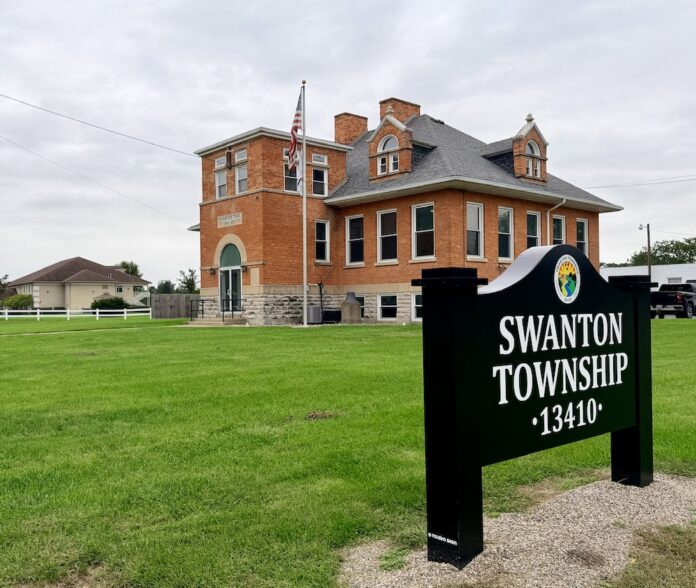
Swanton Township trustees approved a 2-year contract for fire services with the Village of Swanton during a Sept. 22 special meeting. (AWFP photo by Karen Gerhardinger)
SWANTON TOWNSHIP – Swanton Township Trustees approved a two-year contract with the Village of Swanton to provide fire coverage during a special Sept. 22 meeting.
The contract with the village outlines costs of $200,000 for 2027 and $230,000 for 2028, and includes a possible subcontract with the Village of Whitehouse for the southeast portion. Negotiations are underway with Springfield Township to continue covering the northeast portion for $75,000 per year for the next two years.
“This seems to be the cheapest way to get the best coverage. There are other ways, but then we’re right back to having issues with 15- and 16-minute response times,” said Trustee Mike Nowicki. “Calls are continuously going up each year, and the costs are going up each year as well.”
Currently, the township contracts with Springfield Township to cover the northern portion and Whitehouse for the southern. Springfield’s contract expires in 2036, but with Whitehouse’s contract ending on Dec. 31, Trustee Matt Beil began looking at options for fire service as soon as he took office in January.
Bryce Blair, a township resident who serves as safety officer for Whitehouse Fire, asked if one of the options explored included creating its own fire department. That was a consideration, Beil said, but would require much more funding to cover the cost of labor, equipment, insurance and retrofitting buildings and is not considered a feasible option.
“I agree,” Blair said.
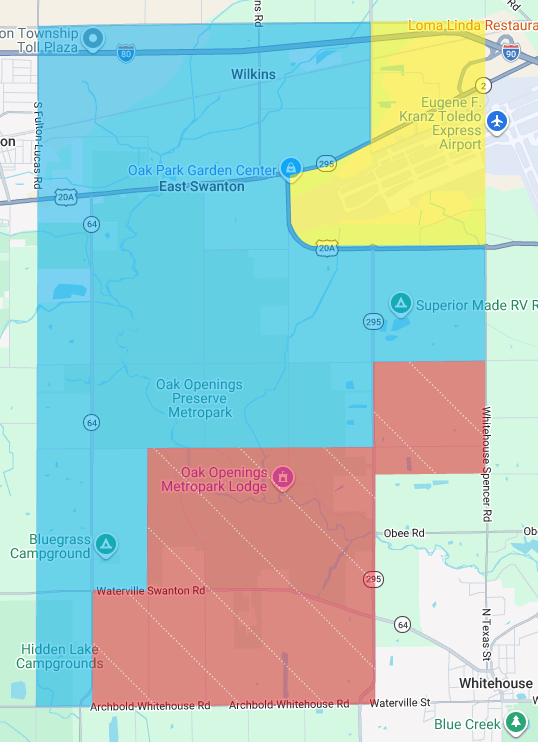
A draft map created by Swanton Fire Chief Cuyler Kepling shows three potential fire protection service areas, with Swanton managing the western, central and northern portions (in blue), Springfield Township covering the Toledo Express Airport and northeast portion (in yellow); and another entity – possibly Whitehouse – covering the area south of the airport (in red).
This draft map of possible coverage areas for Swanton Township shows the village of Swanton covering the blue, Springfield Township covering the yellow, and possibly Whitehouse covering the red portion of the township. Swanton Fire Chief Cuyler Kepling said the map may be altered in the coming few months as negotiations with providers proceed. (Courtesy image)
Talks with leaders of the 180th Ohio Air National Guard Fire Department, which has mutual aid agreements with Springfield and other local departments, led Beil to agree that keeping Springfield’s coverage of the airport and surrounding businesses makes the most sense.
“They [the 180th] are a big proponent of keeping Springfield on because of where they are located and the response time. Springfield has most of our commercial buildings and their fire inspector takes care of all that,” Beil explained.
Another factor in keeping Springfield’s coverage of the businesses is the Knox boxes that contain keys or digital access codes for first responders to enter businesses after hours in case of an emergency. These are keyed for specific fire departments, and the cost to replace the estimated 45 boxes would be about $600 each, Beil said.
Kepling said he’s only had brainstorming sessions with Whitehouse, and nothing has been formalized. Any contract would contain strict performance requirements to ensure that the level of service is equal to or greater than that provided by the Village of Swanton Fire & Rescue Division, he said.
“This includes, but is not limited to, maintaining comparable department capabilities, meeting or exceeding current response times, and ensuring a high standard of service delivery,” Keplin said via email the following day.
“I am confident that any final arrangement will ultimately benefit the residents of the affected area. However, discussions are ongoing, and no final decisions have been made at this time. Residents who may be affected by any changes will be notified of their fire and EMS service provider as soon as practical once agreements have been finalized.”
Trustees approved the contract with Swanton, keeping in mind that both Springfield Township and Whitehouse – if chosen – will need to get approval from their governing boards before contracts can be signed.
“The shared goal of all parties involved is to provide the residents of Swanton Township with the highest possible level of fire and EMS service while ensuring the quickest and most effective emergency response times achievable,” Kepling said.
An existing levy brings in $187,000 a year, and $135,000 is currently used for the fire contracts with Springfield Township and Whitehouse, plus the $25,000 a year estimated cost to pay for county dispatching services. The overage is going into a budget bank that has a balance of $580,000. But with anticipated costs of $275,000 the first year and $350,000 in 2028, Beil said that overage will be nearly used up by mid-2029.
“We need to decide next year if we need a levy,” Beil said, explaining that in talking to the fire chiefs, the estimated cost beginning in 2029 will be “north of $500,000” due to rising costs. “We don’t need the money now but we won’t have enough in the reserves to fund even half of 2029.”
Any levy discussions will be publicly announced and held months ahead of any decision to put a levy on the ballot, Nowicki said. The next year will give the township time to see how the contracts and funding are working before in order to estimate needs for what will likely be a replacement levy.
During the meeting, the board also did a preliminary review of proposed changes to the zoning fee schedule, providing feedback for Zoning Inspector Ben Mooney to make further modifications.
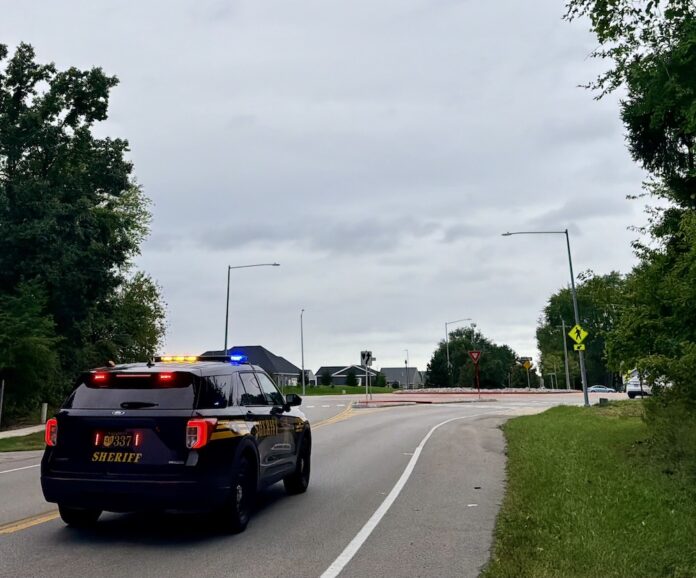
Since the Salisbury-Albon roundabout opened in 2024, area residents have reported an increase in speeders along both roadways, causing dangerous conditions and noise. The trustees authorized the administrator to ask for a speed study through the Lucas County Engineer and ask the Lucas County Sheriff's Office to increase patrols. (AWFP photo by Karen Gerhardinger)
MONCLOVA TOWNSHIP – When Julie Cody pulls in and out of her Salisbury Road driveway, she feels like she’s taking her life in her hands.
“I live on the Salisbury Speedway,” said Cody, whose home is just west of the Albon Road roundabout. “They come down our road at 70 mph and race from Albon to Crissey.”
Cody said she’s had three mailboxes destroyed and has nearly been hit as she’s pulled in or out of her driveway. And she’s not alone. During the Sept. 21 Monclova Township Trustees meeting, Cody and her neighbors shared the near-misses they’ve experienced since the roundabout opened in 2020.
“Going to the mailbox is an adventure,” said Jean-Marie Deschamps, who lives on Salisbury.
“I’ve had people give me the finger or yell and cuss at me when I slow down to go in my driveway. If I’m out checking my mail, it’s a wing and a prayer,” added Albon Road resident Daniel Donkor.
Michael and Marlene Cox live on Summerset in Stoney Creek, and said that the speeding vehicles are so loud that it keeps them up at night. And when Michael approached a deputy sheriff parked at Albon and US 20A about parking on Summerset to look for speeders on Salisbury, “He just shrugged his shoulders,” Michael said.
“Once they built that roundabout, it’s been insane,” Marlene added. “We need help.”
Township Administrator Mike Hampton identified two issues: the speeding and the need for more patrols. The trustees authorized Hampton to contact the Lucas County Engineer to request a speed study in the area, and to speak with the Lucas County Sheriff’s Office about stepping up its enforcement in the area.
It’s up to the Ohio Department of Transportation to set the speed based on the traffic study, and it could reduce the speed limit as a result, Hampton said, noting that Holloway was reduced from 55 to 50 mph after complaints of speeding after a roundabout was completed there.
“It should be 35 mph with no passing lanes,” Cody said. “Lowering it to 50 mph is not enough.”
During the meeting, the trustees also:
-Approved new regulations for residential generators, including five-foot setbacks for permanent auxiliary generators and allowing the short-term use of portable generators for community or private events without a need to seek a permit.
-Asked Zoning Administrator Eric Wagner to finish two other recommended changes to the zoning resolution – to update language on Joint Economic Development Districts (JEDDs) and Zones and also to better define conditional uses – by the Oct. 20 meeting. Wagner said he is meeting with the county senior planner, Molly Maguire, to go over some details later this week.
-Heard Waterside resident Risa Sindel urge trustees to show some movement to provide protection to the township. She also asked whether Monclova was waiting to see the result of Waterville Township’s model of using an M3 planned district before setting its own regulations for data centers.
-Heard that the Strayer Road roundabout should be open by Oct. 16.
-Approved the hiring of two part-time firefighters pending medical exams and drug screenings. Leah McConkey is a certified firefighter II/paramedic from Findlay who currently works as a paramedic for Putnam Co. EMS and as a firefighter with Liberty Township Fire Department. Nathan Rowe is a certified firefighter II/EMT who currently works in the Allen-Clay Joint Fire District and has previous work experience as a combat medic in the U.S. Army.
-Learned that the fire department responded to 200 calls for service in August.
-Heard Fire Chief Matt Homik say that he has been meeting with a renovation committee for review of plans for updates to the department.
-Listened to consultant Kristina White talk about plans for the Saturday, Oct. 3 township open house from 11 a.m. to 2 p.m., with local organizations, food trucks, 4H animals and fire trucks for guests of all ages to check out.
-Heard White say that a Veterans Day blood drive is planned in the township hall meeting room from 9 a.m. to 3 p.m. on Wednesday, Nov. 11.
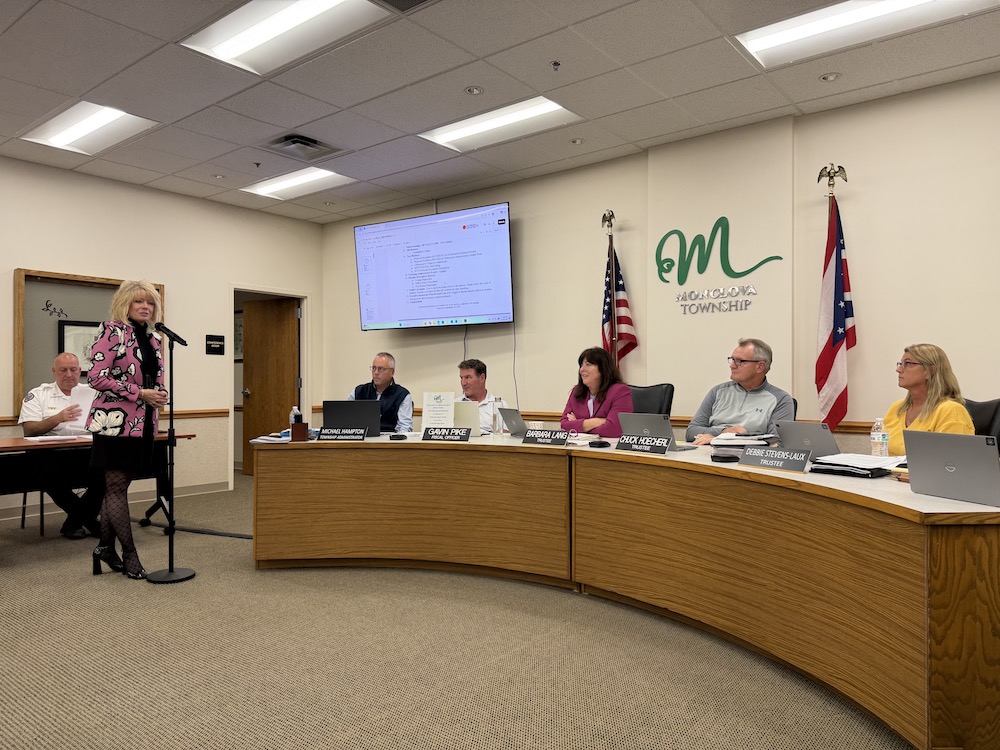
Consultant Kristina White speaks during the Monclova Township Trustees’ Sept. 21 meeting. Listening are (from left) Fire Chief Matt Homik, Administrator Mike Hampton, Fiscal Officer Gavin Pike and Trustees Barbara Lang, Chuck Hoecherl and Debbie Stevens Laux. (AWFP photo by Karen Gerhardinger)
-Listened to resident Roy Bechtel ask trustees to add a second portion of public comments to the agenda, so that residents can speak both on agenda items at the beginning, and on any township-related topic at the end. Locally, the Village of Whitehouse offers these two types of opportunities for public comment during regular council meetings, while other AW-area communities allow comments either at the beginning or end of the meeting.
-Agreed to only meet once in July and once in December due to staff and trustee vacations during those times.
-Joined Swanton Township in approving the inclusion of Cutshall Ditch in the Swan Creek Watershed, following a review by the Lucas County Engineer.
-Learned that at around 7:20 p.m. on Sept. 21, a Monclova Township Fire & Rescue crew was transporting a patient to the hospital when a vehicle pulled out and sideswiped the 2023 unit. According to Chief Homik, the ambulance was driving without lights and sirens on Manley Road in Maumee when a blue Cadillac pulled out of Timberline and was left of center. Quick thinking by the ambulance driver prevented the accident from being a head-on collision, as she veered the ambulance off the road. The Cadillac driver took off without stopping. While the damage was limited to trim, scratches and paint, Maumee Police are looking for any video of the incident. These can be emailed to [email protected].
While Nov. 3 is Election Day, there are, nationwide, millions of ballots that will be cast days in advance — some absentee, others in person. And in Ohio, it’s not long before voters begin making use of both options.
Tuesday, Oct. 6: Early voting starts, absentee ballots begin to be mailed out
While citizens currently abroad, including military members, had their absentee ballots sent out days ago, Oct. 6 is the day when domestic ballots begin to be mailed. If you’ve yet to request an absentee ballot, but need to, you must first fill out an application.
You can request the application form from your county board of elections, by phone, and have them mail it to you. There’s also the option to fill it out online — and from there — print, sign, and return it by mail.
Oct. 27 at 8:30 p.m. is the deadline for absentee ballotapplicationsto be received by county board of elections offices.
Absentee ballots themselves must be returned by 7:30 p.m. on Election Day (with the exception of those from military members and citizens abroad).
Ways of returning an absentee ballot include by mail, leaving it in your county’s secure drop box, or handing it to an official at your county’s board of elections office.
Also on Oct. 6, early in-person voting begins in the Buckeye State. For the first week, polls will be open Tuesday through Friday from 8 a.m. to 5 p.m. Hours do vary week-to-week, which is why it’s best to check out the Ohio Secretary of State’s 2026 Voting Calendar.
While, on Election Day, in-person voting is done at one’s designated polling location, that is not the case for early voting — which, instead, takes place at your county’s early vote location. If you’re unsure of where that is, this interactive tool can provide you an answer in seconds.
What’s on the ballot?
While midterm elections typically have lower turnout than those in presidential years, that doesn’t take away from their importance. This year, for instance, Ohio will be electing a new governor, attorney general, secretary of state, auditor, and treasurer for the first time in eight years. However, those who currently hold these positions — with the exception of governor and AG — are running for different state-level offices.
RELATED:Click here for the Toledo Free Press’ interviews with the Democratic, Republican, and Libertarian nominees for Ohio Secretary of State.
Ohioans will also determine who finishes out the term of JD Vance, who – after becoming vice president – left a vacant U.S. Senate seat. That senate seat is currently occupied by former Lieutenant Governor Jon Husted, who was appointed by outgoing Governor Mike DeWine. While Husted is running to remain in the seat, former Senator Sherrod Brown, a Democrat, is hoping to replace him.
Seats in the House of Representatives are on the ballot, too — including that of Ohio’s 9th Congressional District — currently held by Rep. Marcy Kaptur (D-Toledo). Kaptur faces a rematch from Republican Derek Merrin, who she narrowly defeated in 2024. This year, the majority-Republican Ohio Redistricting Commission — as part of a legally-required mid-decade redistricting process — redrew Kaptur’s district, as well as that of Rep. Greg Landsman (D-Cincinnati), to be even redder. As a result, 12 of Ohio’s 15 congressional districts are now Republican-leaning, three Democratic-leaning, and two tossups (Kaptur and Landsman’s).
Voters will also be electing their state legislators this year. All 99 seats in the Ohio House of Representatives are up for grabs.
RELATED:Click here for the Toledo Free Press’ interviews with State Rep. Erika White (D-Springfield Township) and Republican Ian Chamberlin, candidates in the 41st House District race.
Before May’s primary election, the TFP also spoke to candidates in the 44th House District race. You can find those interviews here, though keep in mind that Ed Schimmel ended up winning the Republican nomination, which narrowed the race down to him and Democrat Dave Fournier.
Also on the ballot: Issue 3 — the ballot measure that, if passed, would enshrine a voter ID requirement in the state constitution. Ohio law already requires voters to provide identification before they can cast a ballot. Proponents argue a constitutional amendment is needed to prevent future general assemblies from changing the law, while criticisms have ranged from it being something that doesn’t belong in a state’s constitution, to it being a way of juicing Republican turnout.
A final note
If you’re unsure of the status of your voter registration, or are unclear about the state or federal House district you reside in, head to VoterLookup.OhioSOS.gov.
(All events are compiled from press releases and other public announcements)
The Toledo area always has something going on, from live shows and family-friendly activities to protests and community meetings. Here are some of the events to check out. If you have something you’d like us to consider adding, please reach out!
Monday, Sept. 21 – The League of Women Voters of Toledo-Lucas County will present “How the Lucas County Board of Elections is Keeping Your Vote Secure” led by Fritz Schoen, BOE Chairman and Kurt Young, BOE Board Member from 6:30-7:30 p.m. at the Heatherdowns Library (3265 Glanzman Rd. – Meeting Room A/B). Speakers will address what voters can expect on election day, but also the other roles/areas of responsibility held by the BOE, including, but not limited to, BOE’s relationship with candidates, the role the Secretary of State plays in elections and how it impacts the BOE and the handling of provisional and mail-in ballots.
Wednesday, Sept. 23 – Toledo Helps Ukraine (THU), in partnership with the Glass City Pearl, will host Wine on the Water, a special evening cruise benefiting THU’s humanitarian efforts in Ukraine. From 6:30-8:30 p.m., guests will enjoy a two-hour cruise along the Maumee River aboard the Glass City Pearl, a wine tasting, and charcuterie boards. Tickets are $75, and seating is limited. Tickets and registration are available online at bit.ly/4g3ERSY.
Saturday, Sept. 26 – ProMedica invites community members to participate in a free outdoor yoga class on the ProMedica Flower Hospital campus (5200 Haroun Rd., Sylvania) from 10 a.m. to noon. Open to people of all ages and fitness levels, the class offers an opportunity to enjoy movement, relaxation and connection in an outdoor setting. An instructor from ProMedica ForeverFit, a medically integrated fitness center, will lead the class. Attendees will also have the opportunity to connect with Mojo from iHeartMedia’s Mojo in the Morning, who will host the event and offer a variety of giveaways throughout the morning.
Saturday, Sept. 26 –Toledo Museum of Art will host its FREE annual Block Party from 3 to 8:30 p.m. Block Party transforms the museum’s lawns, courtyards and terraces into an evening of hands-on creativity and live performance. Guests can expect artmaking stations, roaming performers, food trucks, and a lineup of local and national talent culminating in an 8 p.m. drone show over Monroe Street.
The day’s schedule features:
3:30 p.m. — Sun Ra Arkestra, Moon Mirror
4:45 p.m. — El Corazón de México Ballet Folklórico, Monroe St. Terrace
5:20 p.m. — “Key to the Museum” Presentation, Monroe St. Terrace
5:45 p.m. — DJ Stevie Chanel, Monroe St. Terrace
7 p.m. — The Amelia Airhearts, Monroe St. Terrace
8 p.m. — Art in the Sky Drone Show, Monroe St. Terrace
Saturday, Sept. 26 – Throwback Book Fair for “Grownups” at Way Public Library, 101 E. Indiana Ave., Perrysburg at 6 p.m. An after-hours, 18-and-older event that captures the nostalgia of a school book fair! In addition to your favorite childhood books, they will have “read-alikes,” and recent middle-grade and YA books. Come “shop” the displays, mingle with other book lovers, and sign up for a library card (it’s free!). There will be after-school snacks, a photo booth, and book fair goodies to take home.
Thursday, Oct. 15 – Sunday, Oct. 18 – North American Tour launch of THE BODYGUARD at The Stranahan Theater (4645 Heatherdowns Blvd.). Purchase tickets at BroadwayInToledo.com and StranahanTheater.com. Group ticket savings for 10+ are available by contacting [email protected]. Ticket prices vary by showtime and seating.
Based on the 1992 film starring Whitney Houston and Kevin Costner, THE BODYGUARD is a thrilling, romantic musical that combines high-stakes suspense with unforgettable music. Former Secret Service agent turned bodyguard, Frank Farmer, is hired to protect superstar Rachel Marron from an unknown stalker. Both expect to be in charge of their situation – what they don’t expect is to fall in love. Read more about the show in David Yonke‘s TFP article here.
Friday,Oct. 16 – Party in the Park (Promenade Park) – From 6-9:30 p.m., enjoy Party in the Park on the Road in Uptown District featuring Funk Factory & Not Fast Enuff.
Saturday, Oct. 17 – Lucas County Children’s Services Trunk or Treat will take place from noon to 2 p.m. at the Believe Center (1 Aurora Gonzalez Dr.). At this FREE event, kids can enjoy receiving free candy and seeing mascots and costumed characters.
Toledo Opera’s 2026-2027 season
Beginning in October, the season will feature two main-stage productions.
Tickets can be purchased at toledoopera.org or by phone at 419-255-7464. To learn more about the season, visit toledoopera.org. Read more about the productions in a behind-the-scenes TFP story here.
2026-27 Season Schedule
Aida by Giuseppe Verdi October 16 & 18, 2026 Valentine Theatre
Torn between love and duty, Aida stands at the center of a tempest of passion, loyalty, and impossible choices. Captive in ancient Egypt, the Ethiopian Princess must navigate her love for the heroic Radamès, her devotion to her homeland, and the schemes of the jealous Princess Amneris. Toledo Opera’s original production brings Verdi’s unforgettable arias, soaring duets, and breathtaking choruses to life, immersing audiences in a story of desire, sacrifice, and destiny. Returning to Toledo Opera for the first time in over a decade, Aida is a monumental opera experience not to be missed.
Sung in Italian with English Captions
H.M.S. Pinafore by Arthur Sullivan & W.S. Gilbert
February 19 & 21, 2027
Valentine Theatre
After more than four decades, H.M.S. Pinafore returns to Toledo Opera, bringing Gilbert & Sullivan’s signature wit, music, and high-seas hijinks to life. Onboard, the captain’s daughter Josephine hopes for love with the humble sailor Ralph Rackstraw, despite her father’s plans to marry her to the pompous Sir Joseph Porter. Mischievous sailors, scheming relatives, and the bumbling Little Buttercup, whose long-held secret turns everything upside down, ensure laughter, surprises, and joyous music throughout. This original production combines rousing choruses, clever wordplay, and unforgettable characters for an evening of nautical fun the whole family will enjoy.
Waterville City Council has joined 40 other municipalities in the Better Buildings Northwest Ohio program of the Toledo-Lucas County Port Authority, which opens the door for businesses like the soon-to-open Health 419 to utilize financing programs like Property Assessed Clean Energy (PACE). (AWFP photo by Karen Gerhardinger)
As Health 419 prepares to move into its new Waterville home at 1216 Michigan Ave., the health and wellness provider is getting some help from the Toledo-Lucas County Port Authority. And other businesses in Waterville can now apply for help funding building improvements as well.
During Waterville City Council’s Sept. 14 meeting, Dana Clark, who handles the Better Building Northwest Ohio Property Assessed Clean Energy (PACE) program for the Port Authority, explained how local property owners can utilize fixed rate financing to make improvements that yield energy cost savings. Improvements could include roofing, siding, HVAC, solar, windows and other permanent changes that stay with the building.
Once reviewed by an independent energy auditor, and a thorough financial review to ensure viability, the project cost is then placed on the property’s taxes as an assessment.
The Fuhr Property Group, LLC, is the owner of 1216 Michigan and submitted a petition to finance $83,426.28 in building improvements over 14 years, said Waterville Administrator Jon Gochenour.
For the loan to be approved, the city needs to be part of the Northwest Ohio Advanced Energy Improvement District. But it doesn’t cost the city anything. Council approved three pieces of legislation related to the program, and now Waterville joins 40 other northwest Ohio participating communities.
“Waterville is in a position to help businesses,” Clark said.
The owner of Waterville Animal Group, 210 Farnsworth Rd., is also in the process of applying for PACE financing for roofing, windows, exterior doors and siding, and that application should be coming to council soon, Clark said.
“This is a great partnership,” said Mayor Tim Pedro.
The owner of 210 Farnsworth Rd. and Waterville Animal Group is applying for PACE funding to make improvements to the building and expand into the space currently used by the Dazzled Dog – whose owner is seeking a new location for her dog grooming business. (AWFP photo by Karen Gerhardinger)
During the meeting, council also:
-Authorized the Ohio Department of Transportation (ODOT) to construct a single-lane traffic roundabout at Noward and S.R. 64 in 2028. ODOT will cover the $2.3 million estimated cost and construction will take about 90 days. Gochenour said ODOT did a traffic study after 9 crashes – including six with serious injuries – occurred between 2020 and 2022. In total, 51 crashes occurred between 2017 and 2022, many of them serious. A portion of the roundabout is in the city, and another portion is in Waterville Township.
–Proclaimed Friday, Sept. 25 as Arbor Day in the city. The Tree Commission will host a tree planting ceremony with Waterville students across from the school that day.
-Heard Waterville Area Chamber of Commerce Executive Director Michelle Smith detail plans for the Saturday, Sept. 19 Roche de Boeuf Festival that was held from 9 a.m. to 4 p.m. in downtown Waterville. There was a car show, parade, kids area, vendors, artisans and musicians, along with Waterville Historical Society activities and horse and trolley rides. Read more about the parade here.
-Heard that the city and Scout Troop 101 would be hosting a pre-Roche de Boeuf event on Friday, Sept. 18 with a Run de Boeuf, live music and food trucks in Parker Square.
-Heard that the work on widening Waterville Monclova Road between Pray and Michigan is almost finished. Two other projects are underway: repair and replacement of 5,200 feet of sidewalk; and turn lanes on S.R. 64 between Pray Boulevard and U.S. 24.
-Learned that preparations are underway to replace the waterline next to Waterville Primary School, which has had several breaks – including one on Sept. 15.
-Heard Gochenour say that he expects to have more information soon about the city’s investment in mandated improvements to the county’s sewer treatment plant. This could result in an estimated $93,000 a year increase in the city’s share of operating the plant, and may necessitate increasing sewer rates to residents.
-Learned that Police Chief Joe Valvano will share information on Flock cameras with council during the Sept. 28 meeting. The city has two Flock cameras posted in the city. Both were vandalized recently, and after one was replaced, it was cut down within 36 hours.
-Learned that the annual Christmas celebration will be held on Sunday, Dec. 5 from 5:30 to 8 p.m. in downtown Waterville.
Monclova Township Administrator Mike Hampton speaks to Waterside residents on Sept. 15 about Limited Home Rule, which will be on the Nov. 3 ballot as Issue 30. (AWFP photo by Karen Gerhardinger)
MONCLOVA TOWNSHIP – Loud music, overgrown yards, and junk vehicles on the street are among the issues that lead residents to seek help from Monclova Township staff. But enforcing resolutions and ordinances about noise, weeds, vehicles and other nuisances can be a challenge, Township Administrator Michael Hampton told Waterside community residents during a Sept. 16 presentation.
“Our resolution doesn’t have enough teeth,” Hampton said. “We’re on the front lines taking those complaints…and we want to be able to help them.”
Waterside residents Ann Frahn and Risa Sindel often attend the township’s board of trustees meetings, and heard that the Nov. 3 ballot will contain a question asking Monclova Township residents whether they want to adopt a Limited Home Rule (LHR) form of government. So they invited Hampton, who took over as administrator earlier this year, to visit the 1,000-resident community to explain more on how LHR works.
“It’s a big voting bloc. We thought it would be nice to have information presented so people could make a good decision,” Frahn said.
Townships with a population of 2,500 or more can become LHR governments with a majority vote of the population, and those with 15,000 or more can adopt LHR by a vote of the trustees, but Hampton said Monclova’s trustees want to have residents involved in the decision, even though he expects the township to have a population of nearly 20,000 by the next census in 2030.
LHR was created in 1991 in response to concerns by townships about larger municipalities like Cleveland, Cincinnati and Columbus trying to annex. Currently, 34 of Ohio’s 1,308 townships – including Perrysburg Township and Sylvania Township – have adopted the LHR form of government.
“Limited” is a key word, and Hampton explained that it would not allow Monclova Township to: enact a tax; circumvent Ohio Revised Code; prevent citizens from filing a referendum on legislation; change the zoning resolution or appeals process; change hunting, fishing or trapping rules; alter regulations on agriculture or natural resources; or set elected officials’ salaries above what is outlined in Ohio Revised Code.
“Limited Home Rule helps us battle everyday complaints and issues. It gives us the tools to help you and help us,” Hampton said.
One of the main tools is the ability to issue up to $1,000 in civil fines for violating the township’s resolutions, codes and ordinances. Right now, if a neighbor repeatedly calls the township or the Lucas County Sheriff’s Office about loud music, the most the sheriff can do is give a verbal warning or issue a citation for obstructing the peace. Hampton also pointed out some properties with overgrown grass, weeds and junk.
“Right now, we can send them ‘friendly-grams’ or ‘nasty-grams’ and say that they need to clean that stuff up. They just throw it away,” he said of the notices. With LHR, those notices would include information of a fine up to $1,000 and a 14-day timeframe to respond. He believes hitting violators with the threat of a fine will make a difference.
“We don’t want to harm folks. We just want folks, for health and safety reasons, to be good neighbors,” he said.
LHR can also aid in regulating potential impacts from business and industry, including noise, vibrations, soil erosion and water degradation, some of which are concerns shared about data centers – although Hampton was quick to note that he is not aware of any data center looking at the township.
With the opening of the US 20A interchange, one, if not two, gas stations are being eyed for the corners at Briarfield Boulevard. Having the ability to enforce codes prohibiting long-term parking or overnight stays will enable the township to prevent not only exhaust fumes from running semis but the possibility of prostitution, trafficking and drugs that often accompany truck stops, Hampton said.
One of the requirements of being an LHR government is that the township must have its own law director, which it has already. Currently, the law director has to work through the Lucas County Prosecutor’s office, which is very busy, to try to get codes enforced. With LHR, the law director can take issues and evidence straight to the courts. And if a property owner continually racks up civil offenses, that can equate to a criminal offense, he said.
“This allows more effective local response to everyday complaints,” he said.
Sindel, a Waterside resident, presented information about other townships with LHR, including the large Butler Township, which passed resolutions about impacts from commercial and industrial projects – such as light, noise, even overweight vehicles on the roadways.
Sindel, like resident Dave Burkart, admitted that their initial perceptions of LHR were that it was a move toward Big Brother government – referring to the totalitarian super state in George Orwell’s book, 1984.
“What I’m hearing now, the more I research, is that’s not what it is. We need teeth to preserve and protect our township,” Sindel said.
Burkart said the presentation put his mind at ease.
“It’s more about making the township a better place to be and to get it moving forward. I think it’s a good thing,” he said.
If Limited Home Rule passes in November, it would take effect on Jan. 1, 2027 and last for three years, at which point it would be evaluated, Hampton said. The township previously put LHR on the ballot in November 2024 and it failed, due in part to a lack of communication, Hampton believes.
Residents with questions on Limited Home Rule are encouraged to attend the Saturday, Oct. 3 Public Service Open House, 4335 Albon Rd., from 11 a.m. to 2 p.m. In addition to opportunities to visit with trustees, many local organizations and businesses will be on hand, along with food vendors, farm animals and fire truck visits.
Erin Holden tries her had at kayaking at Wiregrass Lake Metropark with Eric Slough, an avid kayaker who leads classes at the Metroparks and beyond.
This is the final episode of A Walk in the Park with, a WGTE Public Media and Metroparks Toledo collaboration hosted and produced by Erin. Join her as she explores everyday life in Toledo’s Metroparks. In each episode, Erin interviews different park visitors – runners, teachers, artists, parents and more – revealing the many ways people connect with nature. You’ll hear personal stories about people’s relationships with our parks and the activities they cherish. Erin also documents her journey along the way, reflecting on the insights she gains from each experience.
Accounting student Aria Sams and Pre-Nursing student Pauline Agatha at the Owens Community College Findlay-area campus. (Courtesy photo)
(All announcements are 100% compiled from press releases, or otherwise shared by our media partners as credited)
Education news
Owens Community College
Nursing student Caiden Nauth at the Owens Community College Findlay-area campus. (Courtesy photo)
Owens Community College’s enrollment reached its highest 14th-day headcount since before the COVID-19 pandemic, with 7,652 students enrolled for Fall 2026. Compared to 7,423 students in Fall 2025, the 3.1 percent increase for Fall 2026 marks the eighth consecutive semester of headcount enrollment growth and the fifth consecutive fall semester with a headcount increase. Fall 2026 enrollment also represents the largest student enrollment at the 14th-day headcount since Spring 2020.
Additionally, more than 800 students were named to the Owens Dean’s List and Dean’s Recognition in Summer 2026. 30 students from the school’s Toledo-area and Findlay-area campuses were on the Dean’s list, while an additional 825 students earned Dean’s Recognition honors.
Jadyn Lubash. (Courtesy photo)
In other news, an Owens grad is teaching military families’ kids through the Rocket Kids Program in Germany. From swimming in a lake in the Austrian Alps and skydiving in Switzerland to working with the children of American military families living in Germany, recent Owens graduate Jadyn Lubash of Perrysburg Township was chosen to participate as one of eight interns in the Rocket Kids program through University of Toledo. She spent three months in Grafenwoehr, Germany as a student teacher for 5-year-old pre-kindergarten children at Grafenwoehr Training Area, the largest U.S. military training facility in Europe.
Finally, Owens Community College was one of 15 college campuses nationwide selected for Project HOPE, a public art installation tied to National Voter Registration Day. The college marked the occasion Tuesday, Sept. 15 with the project and the third annual Cakes with Blake pancake breakfast in College Hall. A $1,000 National Voter Registration Day Community College Grant supported both events.
Bowling Green State University
At BGSU, the Falcon Marching Band has grown to a record 600 members, becoming the largest collegiate marching band in America and the largest in BGSU history.
In other back-to-school news, BGSU undergraduate students who achieved grade point averages of 3.5 or higher during the Summer 2026 Semester have been named to their respective college’s Dean’s List.
The University of Toledo Foundation today announced that JR Blackburn has been named president and CEO, effective Oct. 12. Blackburn will succeed Brenda Lee, the Foundation’s inaugural president, who has been serving in an interim capacity since May. Lee previously announced her retirement from the Foundation in June 2025.
In other news at UToledo, applications are now open for the Summer 2027 cohort of The University of Toledo’s Doctor of Nursing Practice in Nurse Anesthesia program, with applications being accepted through Sept. 30, 2026. The newly accredited program continues the nurse anesthesia education previously offered at Lourdes University, now under UToledo’s College of Health and Human Services.
Maritime Academy
Maritime Academy of Toledo is celebrating significant progress reflected in the latest Ohio State Report Card, including a substantial increase in its graduation rate and a 3-star Progress rating.
Maritime Academy’s 4-year graduation rate increased from 68.4% to 82.1%, an improvement of nearly 14 percentage points. The school also earned 3 stars in Progress, reflecting academic growth in multiple tested subjects.
The school also reduced chronic absenteeism from 91.2% to 87.4%, exceeding the state’s goal of a 3% reduction.
Health & Environment
UToledo Health is first in the region to offer the LungPacer AeroPace® Neurostimulation System, an FDA-approved therapy proven to get critically ill patients off ventilators faster.
The AeroPace System addresses an issue seen in intensive care units daily. When a patient is on mechanical ventilation, their diaphragm, the primary muscle responsible for breathing, is no longer working. Because the diaphragm is a muscle in constant use, it atrophies rapidly, sometimes within 12 hours of ventilation.
Government & Politics news
Lucas County Prosecuting Attorney Julia R. Bates announced that on Sept. 8, 2026, Lucas County Judge Gary G. Cook sentenced Kevin Richey to 36 to 41 years after he pleaded guilty in case CR2026- 00396 to seven felony offenses, including six counts of rape involving two minors.
Business & nonprofit news
(Courtesy photo)
Georgette’s Coffee launches online store – Coffee lovers can now have Georgette’s wholesale coffee delivered directly to their door, with every purchase supporting life-changing opportunities for people with developmental disabilities. The line includes both 2.5-ounce tear-and-pour options and 12-ounce bags of whole-bean coffee, featuring bestsellers Buckeye Blend, Georgette’s Sunrise and Jamaican Me Crazy and customer favorites like Carrot Cake, inspired by the café’s award-winning recipe. Customers can be among the first to order from the new online store here. Follow the wholesale line Instagram here.
The Arts Commission is now accepting applications for the 2026 Merit Awards, which recognize outstanding work by established and mid-career artists in the literary, performing, and visual arts.
Three artists will receive $4,000 awards to support their continued artistic practice. Eligible artists must have maintained a creative studio or home within 30 miles of downtown Toledo for at least two consecutive years.
The deadline for applications is Sunday, Sept. 27 at 11:59 p.m.
Maumee – CMS Corporation announced that CMS K.K. (CMS), a wholly owned Japanese subsidiary of CMS Corporation, has been awarded a $1.3 million Design-Build project to provide radon mitigation systems across Kadena Air Base, as well as multiple U.S. Marine Corps installations, throughout Okinawa.
Community
Dean Davis Completes 20th “100 Works of Art” Mural withSupport from TECHLEDO – Located at 324 N. Erie Street, the new work celebrates early childhood education, literacy and the special bond between children and animals.
The Association of Zoos and Aquariums honored the Toledo Zoo & Aquarium as one of the seven recipients of the AZA Accreditation Half Century Award for 50 years of excellence. The Half Century Award was first presented in 2024 to two facilities. Including this year’s recipients, only 11 institutions have received the award to date.
Sports
Walleye News – The Toledo Walleye have agreed to terms with forwards Nolan Hutcheson and Johnny Waldron, and with defenseman Jack Duff for the 2026-27 ECHL season, their first full seasons as professionals.
They have also agreed to terms with forward Greg Smith for the season, his first in Toledo, and fourth as a professional.